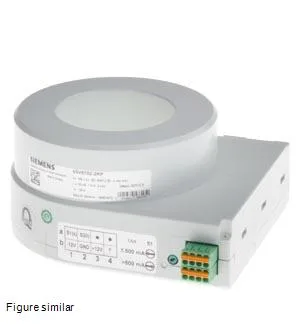
The Type B designation means it detects smooth DC residual currents in addition to AC and pulsed DC — essential for modern installations with variable-speed drives, UPS systems, or EV charging infrastructure where pure DC fault currents can blind standard Type A devices. The 60 mm ID lets you pass up to three main conductors (, L2, L3) plus neutral through the window, or a single busbar up to that diameter. The 160 A rated current sets the maximum continuous load the transformer can monitor without saturating; size the primary circuit so the full-load current stays at or below this figure. Minimum residual current detection starts at 10 mA, so the device can pick up very small leakage paths — useful for personnel protection or ground-fault monitoring in sensitive circuits. The rated surge voltage withstand is 8 kV, which covers the impulse category for 400/690 V distribution panels without additional surge suppression on the transformer itself.
DIN-rail integration and wiring constraints
Mounts on standard DIN rail; dimensions are 135 mm wide, 67 mm high, and 116.4 mm deep. The 116.4 mm depth is the key clearance dimension when the transformer sits behind a panel door or inside a shallow enclosure — check that the door clearance or back-panel depth exceeds this figure before committing the layout. Connection is via plug-in terminals rated for 6 x 0.75 mm² conductors, so secondary wiring to the RCD or evaluation unit uses small cross-sections. The maximum secondary wire length is 10 m; keep the run short to avoid voltage drop or noise pickup on the residual signal. Terminals are IP20 — suitable for dry indoor panels only. If the panel sits in an unconditioned space that drops below freezing or exceeds 55 °C, the transformer must be relocated or derated per the manufacturer's thermal curve.