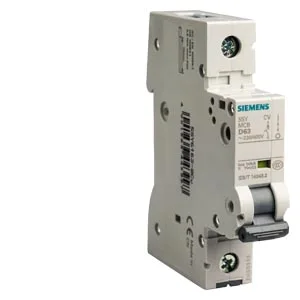
It's built for industrial panel duty — mechanical engineering and industry applications per the spec — where high inrush currents from motor starters, transformers, or power supplies would nuisance-trip a C-curve breaker. The D curve means it holds through starting surges up to 10–20× rated current before opening, so it's the right pick for the load side of a motor branch circuit, not the lighting or socket-outlet circuit.
Rated 15 kA at 230/400 V AC (multi-phase) per IEC 60947-2. For a 400 V industrial panel with a transformer kVA rating that keeps prospective fault current under that number, this breaker coordinates. AC operating voltage: 230 V single-phase, 440 V multi-phase. DC maximum is 72 V — so it's usable on DC control circuits up to 48 V nominal, but not for 110 V DC battery banks. Frequency 50/60 Hz, standard mains. Mechanical service life 10,000 operating cycles typical. Vibration resistance per IEC 60068-2-6: ±1 mm at 5–25 Hz, 50 m/s² at 25–150 Hz — survives the shake of a conveyor line or compressor skid. Temperature range -40 °C to 75 °C, with derating on humidity above 55 °C (max 95% RH at 55 °C, tapering to 35% at 75 °C).
Combined terminals top and bottom — accepts both busbar and conductor without swapping parts. Sealable with a lead seal or wire seal for metering or safety isolation circuits where tamper evidence is required. Neutral conductor switching is not provided (single-pole only, no switched neutral). Supply cord position any — no orientation constraint when landing the feed.