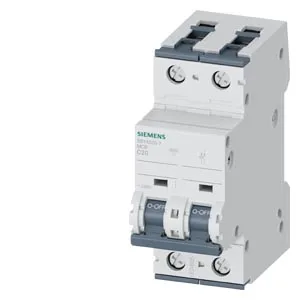
Breaking capacity sits at 10 kA per EN 60898-1, 20 kA per IEC 60947-2, and 15 kA at DC per IEC 60947-2 — that's the fault current it can safely interrupt without welding contacts or venting arc gas into the panel. At 230 V AC single-phase it's rated for 250 V max; DC side tops out at 72 V. Two modular-width units (36 mm) on the DIN rail, 70 mm installation depth, IP20 with conductors connected.
Breaking capacity across standards — what it means for panel coordination
The 5SY4520-7 carries four distinct interrupting ratings depending on which standard governs your installation. Under EN 60898-1 (the household / similar installation standard) it's rated 10 kA. Under IEC 60947-2 (industrial control-panel standard) it jumps to 20 kA. At DC per IEC 60947-2 it's 15 kA. Under UL 1077 / CSA C22.2 No.235 it's 5 kA. That spread matters for selectivity: if your upstream breaker is rated 25 kA and this downstream device only 10 kA, you need to verify the let-through energy (I²t) doesn't exceed the downstream withstand. The 20 kA IEC rating gives headroom for most industrial panelboards without cascading coordination studies. The UL 1077 listing at 5 kA is supplementary protection — not a branch-circuit rated device under UL 489, so it's for internal panel sub-circuits, not service-entrance positions.
Two modular-width units (36 mm) at 70 mm installation depth (76 mm overall depth including the front projection). IP20 with conductors connected means the busbar stabs and terminals are touch-safe only when wired; the front face is protected but the interior of the panel must be kept free of live accidental contact. Sealable per the spec — a lockable cover or seal cap can be fitted to prevent unauthorized switching. Neutral conductor is switched (1P+N), so the neutral is opened and closed with the phase — required in some regional schemes where the neutral must not remain live when the breaker is off.