Panel fit and wiring constraints
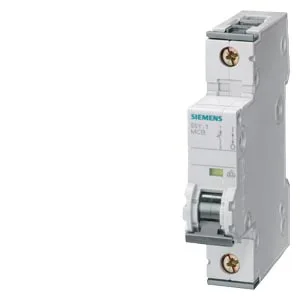
Width is 18 mm — one standard DIN-rail width unit — so it occupies a single slot on the rail. That 76 mm depth is the same as the 5SL3120-6MB peer, so if you're swapping into a panel built for that 5SL series, the envelope matches without re-drilling gland plates or re-routing cable bundles. Tightening torque is 2.5 to 3.5 N·m (22 to 31 lbf·in), which is typical for screw terminals on this class of breaker. Both top and bottom terminals are combined (line and load can land on either side), and the unit is sealable for tamper-proofing in metered or secured installations. Polarity must be observed on the DC supply — the datasheet notes 'Consider polarity' on the power supply connection.
The closest functional peer in the SENTRON family is the 5SL3120-6MB. Both are 1-pole, 18 mm wide, 76 mm deep, with B-curve tripping and IP20 touch protection. The critical difference: the 5SL3120-6MB is an AC-only breaker (rated 400 V AC, 4.5 kA per EN 60898), while the 5SY5140-6CC11 is a DC-rated universal-current breaker (220 V DC, 10 kA per IEC 60947-2). If your circuit is DC, the 5SL won't work — its DC breaking capacity is not specified. If your circuit is AC, the 5SY will still function (it's rated for 230/400 V AC as well per the description), but you're paying for the DC rating and railway qualification you may not need. Wire range on the 5SY goes up to 35 mm² solid/stranded; the 5SL tops out at 25 mm². Ambient temperature range is wider on the 5SY (-40 to +70 °C vs -25 to +45 °C). So if you're in a hot cabinet or cold outdoor location, the 5SY is the correct choice regardless of voltage type.