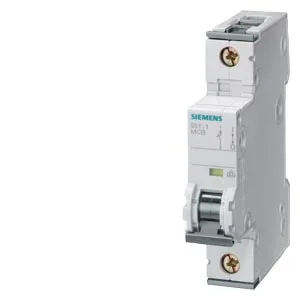
Siemens SENTRON 5SY7140-7 — 1-pole C-curve MCB for industrial branch circuits
The Siemens 5SY7140-7 is a 1-pole miniature circuit breaker from the SENTRON family, designed for 400 VAC branch-circuit protection in industrial control panels and machinery. Its C-curve tripping characteristic (magnetic release at 5–10× rated current) suits moderate inrush loads like small motors, contactor coils, and control transformers — common in mechanical engineering and industry applications. Rated breaking capacity reaches 15 kA per EN 60898 and 20 kA per IEC 60947-2, with a DC rating of 15 kA at 60 V (max 72 V). UL 1077 listing holds 5 kA at 440 V for North American acceptance. The single-module (18 mm) width and 70 mm installation depth let it snap onto standard DIN rail in any mounting position, with combined top and bottom terminals for daisy-chaining busbars.
Breaking capacity across standards — what the ratings mean for panel coordination
The 15 kA rating under EN 60898 covers residential and light commercial distribution boards; the 20 kA under IEC 60947-2 is the figure to use for industrial panel SCCR calculations where the breaker is the first OCPD after the main disconnect. For DC circuits, the 15 kA at 60 V (72 V max) applies to battery-backed control supplies or DC bus protection — verify the system voltage stays within the 72 V ceiling. The UL 1077 supplementary-protector listing (5 kA at 440 V) means this breaker cannot serve as the sole branch-circuit OCPD in a UL 508A panel; it protects downstream loads after a listed branch fuse or circuit breaker.
Lifecycle and sourcing — active production, quoted to order
The 5SY7140-7 carries a current lifecycle status — no phase-out or last-time-buy notice on record.
Panel integration — DIN-rail fit, terminal detail, environmental limits
Width of 18 mm (one modular unit) and depth of 76 mm (70 mm installation depth) fit standard DIN-rail enclosures; the quick-assembly system allows tool-less snapping onto the rail. Combined top and bottom terminals accept busbar feed-through; the neutral conductor is not switched (1-pole design). Operating temperature spans -40 °C to 75 °C, with humidity derating above 55 °C (95% RH to 55 °C, 55% to 70 °C, 35% to 75 °C). Pollution degree 3 and overvoltage category III suit industrial environments with conductive contamination. IP20 with connected conductors — protected against finger contact but not water ingress; install inside a rated enclosure.
