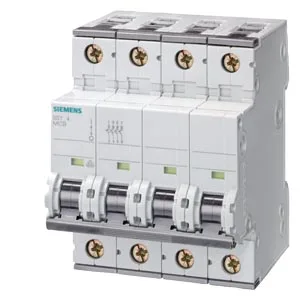
What it is and what it does
The Siemens 5SY7450-7 is a 4-pole miniature circuit breaker (MCB) from the SENTRON series, designed for branch-circuit overcurrent and short-circuit protection in industrial control panels. It carries the C tripping characteristic, so it handles moderate inrush from motor starters and transformer primaries without nuisance tripping — the magnetic trip kicks in at 5 to 10 times rated current. Rated breaking capacity depends on which standard you're working to: 15 kA per IEC/EN 60898-1, 20 kA per IEC 60947-2, and 5 kA per UL 1077 / CSA C22.2 No.235. That dual rating means the same part satisfies both IEC and North American panel builds — useful when a machine ships globally or the BOM crosses standards.
Ratings that matter for the panel
It's rated 400 V AC for multi-phase operation, 440 V AC for single-phase, and 60 V DC (72 V DC max). The 4-pole design switches all three phases plus neutral, though neutral conductor switching is not included — the neutral pole is a switched pole only if wired accordingly. Pollution degree 3 and overvoltage category III suit it for fixed industrial installations where conductive dust or humidity is present. The 72 mm width (4 modular units) snaps onto a DIN rail via the quick assembly system; mounting position is any, so vertical or horizontal panel layouts work. Depth is 76 mm with 70 mm installation depth behind the panel — enough to clear most backpanel wiring troughs.
Where it goes
This MCB is suited for mechanical engineering and industrial environments — think control cabinets on conveyor systems, pump skids, or packaging lines where a 4-pole C-curve breaker protects a mixed resistive-inductive load. The IP20 rating (with connected conductors) is standard for enclosed panel mounting; keep it behind a cabinet door or cover. Temperature range from -40 °C to 75 °C covers most plant-floor conditions, including unheated warehouses and near-oven zones. The sealable design allows the panel builder to lock the handle position with a padlock — useful for lockout/tagout procedures during maintenance.