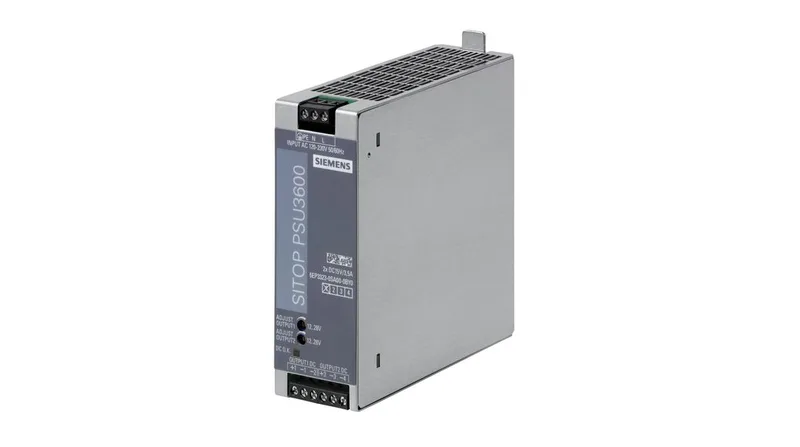
The Siemens 6EP3323-0SA00-0BY0 is a SITOP PSU8200 power supply with two isolated outputs, each rated 3.5 A continuous and 60 W maximum. It accepts AC input from 120 to 230 V (47–63 Hz) or DC input from 88 to 250 V, making it usable across both mains and battery-backed DC bus applications. The unit snaps onto a standard DIN rail (EN 60715 35×7.5/15) and is IP20 rated for dry indoor panel environments. Each output is NEC Class 2 per UL 1310, which means the power is limited enough that downstream wiring can follow Class 2 rules — no conduit or heavy-gauge armor needed for the load side. The whole supply carries cULus listing to UL 508 and CSA C22.2 No. 107.1 (file E197259), so it's accepted for industrial control panels in North America without extra agency review.
The headline number is 3.5 A per output, but the real constraint is the 60 W per-output ceiling. At 24 VDC typical load, 3.5 A × 24 V = 84 W, which exceeds the 60 W limit — so the current must be derated to 2.5 A per output at 24 V. If you're driving 24 V sensors or actuators, plan for 2.5 A per channel maximum, not the full 3.5 A. The supply also has a total package limit of 1 A²·s I²t, which governs inrush handling for capacitive loads. Input derating matters: below 110 V AC/DC, the maximum output power drops to 100 W total (shared across both outputs). At 85 V input the supply still regulates, but output power is capped. On a 120 V line this is fine; on a weak 110 V feed or a battery string at end-of-discharge, watch the load budget. Ambient derating kicks in above 60 °C: output current must be reduced by 2% per °K up to 70 °C maximum operating temperature. In a hot cabinet near drives or transformers, this can cut available current by 20%.
The unit snaps onto DIN rail EN 60715 35×7.5/15. Required clearance: 50 mm above and below the unit for airflow and wiring access; 0 mm left and right, so units can be ganged side-by-side without gaps.
The supply is CE marked, carries EAC approval, and has C-Tick (Australian) certification. It is not ATEX or IECEx rated, and not approved for hazardous locations (UL HazLoc no). For ordinary industrial environments, the compliance box is fully ticked.