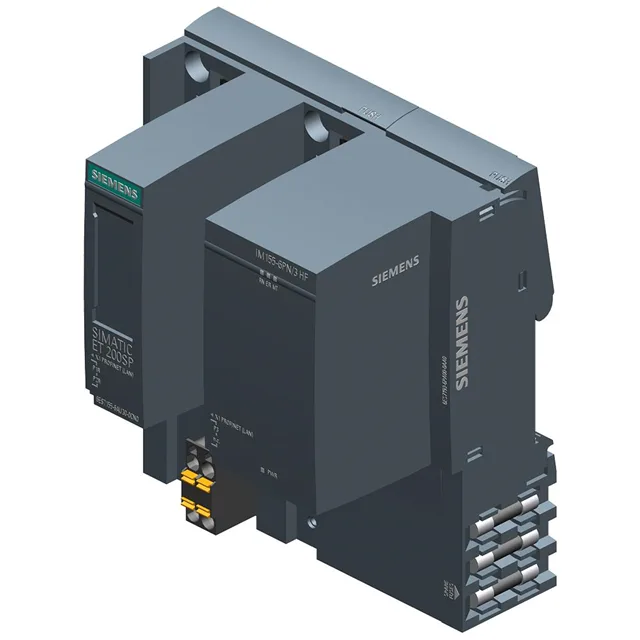
The Siemens 6ES7155-6AU30-0CN0 is a SIMATIC ET 200SP PROFINET interface module — the head-end that ties an ET 200SP station (or, via a send BU/BA, an ET 200AL island of up to 16 additional modules) onto a PROFINET network. It carries three Ethernet ports through two BusAdapter slots rather than fixed RJ-45 sockets, so the physical media (copper, fiber, mixed) is a slot decision, not a chassis decision.
Timing and redundancy — what the spec actually buys you
IRT is supported across a 250 µs to 4 ms send clock, stepped in 125 µs increments — that range is what determines whether the application fits isochronous motion or stays in standard RT. Maximum jitter is held to 1 µs and equidistance plus H-Sync forwarding are both enabled, so the module is positioned for drives or high-speed I/O where the deterministic gap between cycles matters as much as the cycle itself. PROFINET MRP media redundancy is on the table; MRPD is not — if the design relies on MRPD for parallel-redundant ring reconfiguration, this head-end will not carry it.
Diagnostics, security, and shared-device posture
Status is reported through three front-panel LEDs — green RUN, red ERROR, yellow MAINT — which mirrors the standard Siemens PROFINET diagnostics vocabulary the maintenance tech will already read. Alarms, SNMP, LLDP, and TCP/IP are all on; Modbus TCP is not. Shared-device mode is supported, so two controllers can split the downstream I/O across one head-end when the architecture calls for it. Security is documented against Security Level 1 Test Cases V1.1.1, and I&M0 through I&M3 are populated for asset identification in the engineering tool. PROFIenergy is supported and the module ships at firmware V4.2 — pin that version in the project before commissioning so the controller-side GSD matches the head-end in the cabinet.
Mechanical and environmental envelope
The module occupies 100 mm of DIN-rail width, stands 117 mm tall, and sits 74 mm into the cabinet — no BusAdapter fitted, the unit is approximately 220 g. Autonegotiation and autocrossing are handled by the BusAdapter, so the physical Ethernet segment does not need a manual switch setting; tool-changer docking is supported on both the docking station and docking unit for robotics-side applications. Strain relief is an optional accessory rather than a fixed feature — order it as a separate line if the cabinet sees vibration or if the cable routing puts lateral load on the BusAdapter.