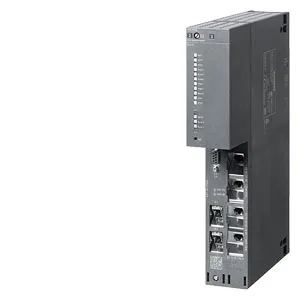
CPU 410-5H — the fault-tolerant controller for S7-400H systems
The Siemens 6ES7410-5HM08-0AB0 is a CPU 410-5H, the processor for a redundant S7-400H system. It runs a 450 MHz multi-processor system, which means it handles the cycle times and data throughput expected in a high-availability application — think redundant process control or safety-instrumented systems where a single CPU failure can't stop the line. This CPU includes an integrated PROFINET interface and a separate PROFIBUS DP port, so you can talk to remote I/O and drives without adding a separate communications processor. It also supports TCP/IP and UDP via the PROFINET port and loadable function blocks, plus MODBUS RTU as an add-on — good for tying in legacy devices or a third-party HMI. I/O data volume per interface is 2,048 bytes, with a maximum of 1,536 bytes for inputs or outputs.
The 450 MHz clock speed isn't just a number — it determines how fast the CPU can execute the control logic and handle interrupts. In a redundant pair, both CPUs must stay in sync; a faster processor reduces the window for data inconsistency between the two units. The ATEX marking ATEX II 3G Ex ec IIC T4 Gc means the CPU is certified for use in Zone 2 gas atmospheres (explosive gas present less than 10 hours per year) with a T4 temperature class (135 °C max surface temperature). That's a common requirement for chemical, pharmaceutical, and oil & gas installations where the controller sits in a non-hazardous area but the I/O or field wiring enters a classified zone. The CPU itself is not intended for direct mounting inside Zone 2 — it's the system-level certification that matters for the panel builder's declaration of conformity. The CCC (China Compulsory Certification) and cULus marks tell you the part is accepted in the Chinese and North American markets without additional agency review. CE mark covers the European Economic Area. If your BOM requires any of these, the CPU carries them from the factory — no separate certification project needed. If your panel runs hotter than that — near a furnace line or in a non-ventilated enclosure — you'll need to derate or add forced cooling.
The CPU is 50 mm wide, 290 mm tall, and 219 mm deep. The CPU has an isolated backplane interface, so it won't couple noise from the power supply into the I/O bus. That matters in a panel with VFDs or contactors — the isolation keeps the control logic clean.