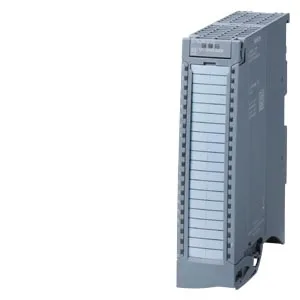
What you're slotting into the rack
The Siemens 6ES7521-7BH00-0AB0 is a SIMATIC S7-1500 digital input module: 16 inputs at a 24 V rated value, with MSI support and a P-reading source/sink input characteristic on each channel. It is not a plain DI — the module carries a 32-bit counting width, hardware and software gate start/stop, and a minimum resolution of 15.625 µs, which is why the 7BH00 suffix gets pulled into a BOM instead of a basic high-feature DI. Footprint is the standard S7-1500 slice: 35 mm wide, 147 mm tall, 129 mm deep, approximately 240 g, drawing about 7 W of backplane power loss under typical load.
Counting and oversampling — the reason it isn't a 1BH00
Beyond a 24 V digital input with wire-break detection down to I < 350 µA, the module is parameterizable for pulse extension in six steps (0.05 / 0.1 / 0.2 / 0.5 / 1 / 2 s) and supports both positive and negative edge evaluation. Oversampling is enabled on the module, isochronous mode is supported, and the firmware version field reads V1.0.0 with field-update capability — relevant if the rack is being modernized against an existing TIA Portal project.
Signal levels, timing, and cable runs
Input thresholds are the standard S7-1500 24 V DI curve: signal '1' is recognized between +11 and +30 V, signal '0' between -30 and +5 V. Edge-to-edge timing spans 0.05 ms minimum to 20 ms maximum in both directions, so the same channel can serve a fast counter and a debounced limit switch. Cable runs are governed by the input frequency and shielding: up to 1 000 m shielded (600 m when used for technological functions), 600 m unshielded for plain DI use, and 50 m is the published ceiling at 20 kHz on the counter channels.
Diagnostics, identification, and panel-side reading
The module carries a green RUN LED, a red ERROR LED, a diagnostic alarm, hardware interrupt capability, and I&M0 through I&M3 identification data — the level of asset-tag and alarm reporting expected of an S7-1500 slice. Two-wire sensors are supported; short-circuit to the supply is not a published diagnostic on this module, so protect the field wiring externally if the cabinet layout exposes the run to a chafe path.
Lifecycle stage is recorded as current, so the module remains in normal production rather than being NRND or discontinued.