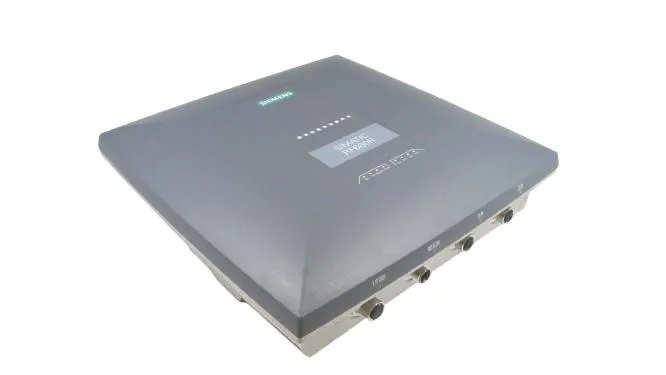
RFID Reader for Industrial Identification
The Siemens 6GT2811-6AA10-1AA0 is an RF600-series RFID reader that reads and writes to RF600 transponders. It operates in the 902-928 MHz UHF band with a maximum read range of 8 m, and extended ranges are possible per the RF600 System Manual. The reader integrates directly to Ethernet, PROFINET IO, or EtherNet/IP networks and includes an embedded OPC UA server, so it publishes tag data without a separate middleware PC.
Integration and Mounting
Mounts on a standard 35 mm top-hat DIN rail or on the profile rail of S7-300, S7-1200, or S7-1500 controllers. Also supports VESA 100 pattern with 4x M4 screws for panel mounting. The housing is IP65-rated, so it can be placed directly on the factory floor near the read zone rather than inside a sealed cabinet — saves panel space and antenna cable run. Power comes via an M12 8-pin connector at 24 V DC nominal (20-30 V range). Typical draw is 0.38 A; budget for 2 A at peak to cover antenna power and startup transients. The reader supports up to four external antennas via RP-TNC connectors, with a maximum cable length of 40 m per antenna.
Network and Protocol Support
Ships with TCP/IP, PROFINET IO, and EtherNet/IP protocol stacks onboard. DCP (Discovery and Configuration Protocol) and LLDP (Link Layer Discovery Protocol) are supported for network setup and topology mapping. SNMP v1 is available for basic monitoring; v2 and v3 are not supported. The OPC UA server is integrated — no extra license or gateway hardware needed for MES or SCADA connectivity.
Environmental and Lifecycle
Rated for operation from -25 °C to +55 °C, with storage and transport tolerance from -40 °C to +85 °C. Shock resistance per EN 60068-2-27 at 250 m/s², vibration per EN 60068-2-6 at 30 m/s². The lifecycle stage is listed as mature — meaning it is a stable, widely deployed product without active phase-out notice. Sourced to order against an RFQ; typical supply posture is quoted per request.
Digital I/O and Display
Includes 4 digital inputs and 4 digital outputs for local control signals — useful for triggering read cycles or signaling a good/bad read to a PLC without network round trips. The front panel has two rows of LEDs (8 and 9 LEDs) for status indication: power, network link, and read activity at a glance.