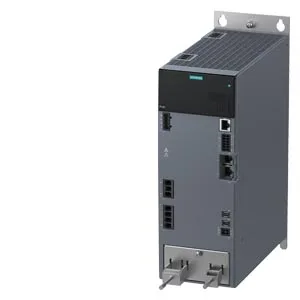
What this drive sits down next to on the bench
The Siemens 6SL5310-1BE17-0DF1 is a SINAMICS S210 single-axis servo converter sized for a 7.0 kW motor shaft load on a 200-480 V 3AC supply drawing 17.9 A at 45-66 Hz, with a 0-550 Hz output stage rated 15.0 A. (cites:,). Frame size C with a 105 x 322 x 223 mm (W x H x D) chassis and IP20 protection class puts it into a cabinet-mounted, control-panel role rather than a sealed field enclosure, so the drive typically lives behind the panel door next to the contactor and the 24 V backplane supply. (cites:).
Reading the input and output windows
The 200-480 V 3AC window with a ±10 % tolerance spans the common global industrial supplies, so the same chassis can be commissioned on a 400 V European feed or a 480 V North American feed without a tap change. The 17.9 A input figure is the line-side continuous draw at rated load, and the 15.0 A output ceiling caps the motor-side current the drive will deliver before current limiting clamps the loop. (cites:). The 0 V starting point on the output voltage ramp is normal for a drive that uses a controlled pre-charge before enabling the inverter stage; the 0-550 Hz output ceiling is the speed-reference limit the drive will command into the connected motor, not the carrier frequency. (cites:).
Group codes and how they show up on the PO
The Siemens internal Group Code R220 and Product Group 4R30 are the fields the back office sees on order acknowledgements and packing lists; matching those against the procurement record is how a buyer confirms the exact variant landed rather than a near-code sibling. (cites:,). Inbound packaging is a single-piece carton at 345.00 x 400.00 x 115.00 mm, and the quantity unit is 1 piece, so each ordered unit is its own parcel and the carton dimensions drive the shelf footprint on receipt. (cites:,).
Quoting and getting a confirmed delivery date
Pricing and live availability for the 6SL5310-1BE17-0DF1 are confirmed against the RFQ at quote time — production quantities run through independent distribution on a quoted-to-order basis, with the volume break and lead date set when the BOM line is presented. (cites:).