Output and loop integration
The 266GSTVKBNB1L1M5 delivers a 4 to 20 mA analog signal with superimposed HART digital communication — the standard two-wire loop for process transmitters. The HART protocol lets a DCS or handheld communicator read the process variable and configuration without breaking the loop. For a field-service tech pulling a swap, the loop draw at 24 VDC nominal sits within the typical 3.6–23 mA range; verify the HART master is set for the same polling address before commissioning.
Sensor span and overpressure limits
Span limits run from 600 kPa to 60000 kPa (6–600 bar, 87–8700 psi), with an overpressure limit of 90 MPa (900 bar, 13050 psi). That overpressure rating is the maximum the sensor cell can survive without zero shift — useful for a line that sees occasional surge events. The V code in the order code selects this span range; if your process runs near the low end, the turndown ratio is generous enough to keep accuracy within the published spec.
Wetted materials and process connection
Diaphragm material is Hastelloy C-276 with silicone oil fill, and the selection is NACE compliant (MR0175 / MR0103) — so it is rated for sour-gas service where sulfide stress cracking is a concern. The process connection is 316L stainless steel, 1/2-14 NPT female, also NACE. If the line media is compatible with Hastelloy and the fill fluid is acceptable for the temperature range (silicone oil typically covers –40 to +120 °C), this transmitter is ready for chemical or hydrocarbon duty.
Housing and electrical connection
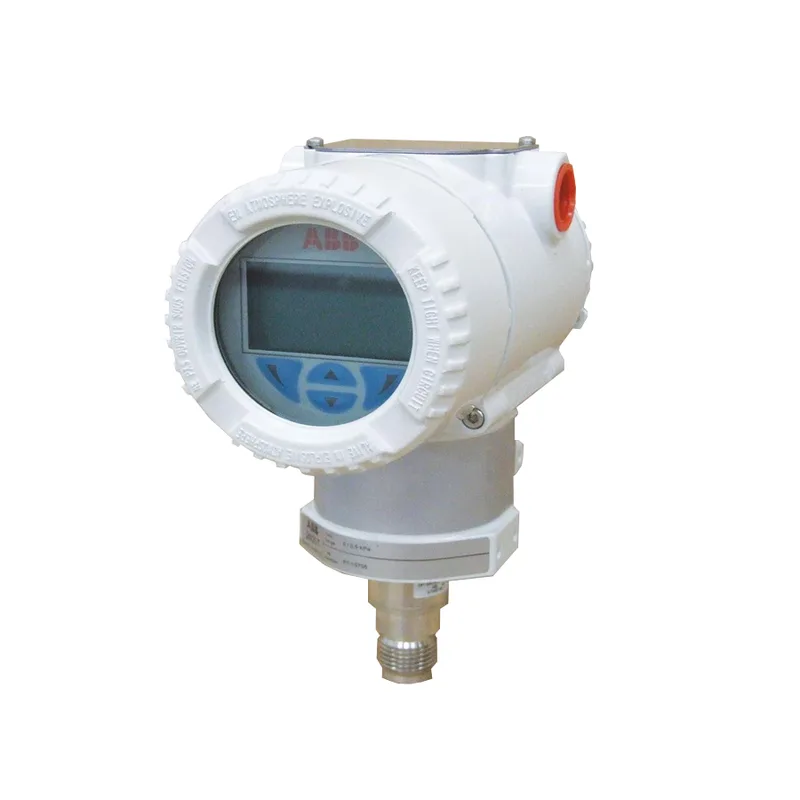
The housing is aluminium alloy in a barrel-type form factor, with an M20 x 1.5 electrical entry. That is a common metric conduit thread; if the site uses NPT conduit, an adapter is needed. The barrel style is compact for tight pipe stands or manifold mounts. The integral LCD display (L1 option) shows the process value and diagnostic codes locally — no need to open the cover for a quick read.