What you're specifying
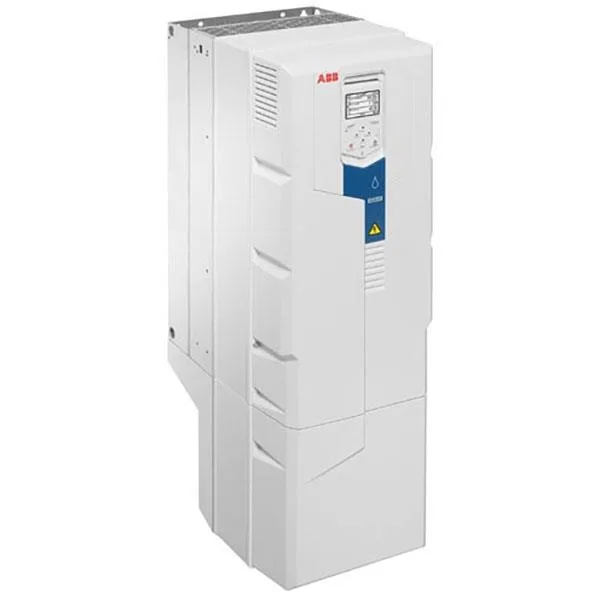
The ABB ACQ580-01-052A-4 is the water-and-wastewater variant of ABB's ACQ580-01 drive family, a low-voltage AC drive aimed squarely at pump and blower duty in municipal and industrial water service. At 19.01 kg it sits in the same wall-mount frame class as the general-purpose ACS580-01 line, so cabinet layout, gland plate sizing, and lifting handling all carry over without redrawing the panel. The application-specific firmware inside the ACQ580 is what separates it from a generic industrial drive — pump curves, multipump control, and wet-end protection logic are part of the appliance, not an aftermarket option.
Why the family matters for this BOM line
ACQ580-01 drives are sized around constant-torque and quadratic-torque loads typical of raw-water intake, aeration blowers, and chemical-feed pumps, so the rating chain is built for those profiles rather than for general-purpose machinery. Because the ACQ580 and ACS580 share a common platform, the I/O map, control terminals, and fieldbus option-slot conventions match — a controls integrator porting the application logic between the two families is working in the same parameter structure rather than learning a new one.
Cross-shop against the ACS580-01-065A-4
The closest functional second-source on the same platform is the ACS580-01-065A-4, a general-purpose ACS580-01 drive from ABB at 19.05 kg — within rounding of this unit and in the same wall-mount footprint, so cabinet cutouts and mounting hardware carry over directly. What differs is the application firmware: the ACS580 is a general-purpose drive for variable-torque and constant-torque industrial loads, while the ACQ580 carries the water/wastewater pump-control and multipump logic the ACS580 does not have loaded by default. That makes the ACS580-01-065A-4 a drop-in panel replacement from a mechanical and wiring standpoint, but not a functional one for a site that depends on the built-in pump-control macros — the application would have to be re-implemented on the general-purpose firmware.
Sourcing posture
For an MRO spare holding, the safest play is to quote against the RFQ with the application firmware revision pinned, so the replacement unit matches the existing pump-control parameter set when it lands.