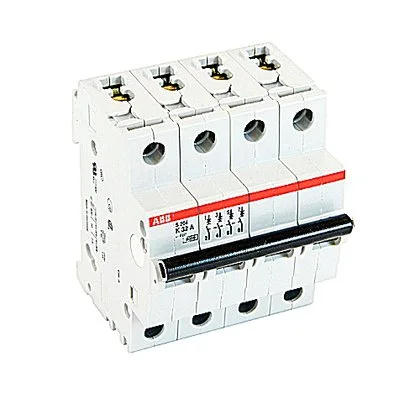
The 10 kA interrupting capacity at 277 VAC handles fault currents typical in commercial and light industrial branch circuits — enough to coordinate with upstream protection without cascading failures.
Trip Curve K is the deciding spec here — it's the magnetic trip threshold. Curve K holds the thermal element at the same 32 A continuous rating but sets the magnetic instantaneous trip at 10–14× In (320–448 A). That's higher than Curve C (5–10×) and lower than Curve Z (2–3×). It's sized for loads with moderate inrush — motor starters, transformers, or lighting ballasts — where you need to ride through the startup spike without nuisance tripping, but still clear a hard short fast. The 4-pole configuration means all four poles switch and protect together — used on 3-phase + neutral systems where you want coordinated disconnection of all live conductors. Common in European-style distribution boards feeding mixed single-phase and three-phase loads. DIN-rail mounting clips onto standard 35 mm rail (EN 60715). No panel cutouts, no screw-down — snap it in, bus it, wire it.
The closest sibling is the S204-B32 — same 32 A, 4-pole, 277 VAC, 10 kA interrupting rating, same DIN-rail footprint. The only difference is the trip curve: B-curve trips magnetically at 3–5× In (96–160 A), so it's for resistive or low-inrush loads (heaters, incandescent lighting). The K-curve on this part handles the higher inrush of inductive loads. Physically they swap into the same panel slot — no rewiring needed — but the coordination study changes. If the existing panel was specced around B-curve, dropping in a K-curve without checking the load profile risks nuisance trips on resistive circuits or failure to trip fast enough on a hard fault.