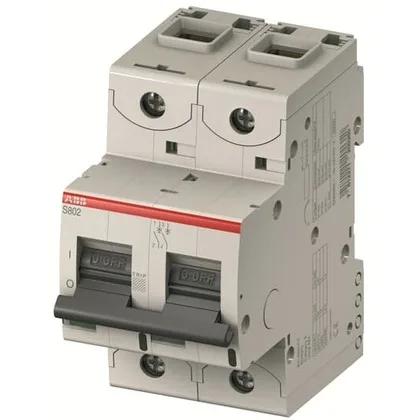
The ABB S802S-K0.5 is a miniature circuit breaker from the S800S series, configured as a 2-pole unit with a K-trip characteristic. This is the part you'd reach for when you need selective coordination on a motor branch or a high-inrush load where a standard B or C curve would nuisance trip. The K-curve means it holds through the starting surge of a small motor or transformer — let me show you why that matters for the panel: it sits between the C and D curves on magnetic trip threshold, so it's tight enough for cable protection but forgiving enough for inductive kicks.
What the K-curve means for fit
The K characteristic on this 2-pole breaker is the detail that decides the fit. K-curve breakers have a magnetic trip threshold of 8 to 12 times In — that's higher than a C-curve (5-10x In) but lower than a D-curve (10-20x In). For the S802S-K0.5 rated at 0.5 A, that means the magnetic trip fires somewhere between 4 A and 6 A of fault current. Why does that matter? Because a 0.5 A motor inrush can hit 4-5 A for a few cycles, and a C-curve might see that as a fault and trip. The K-curve gives you the headroom to start the load without false trips, while still protecting the cable from a hard short. If you're specifying this into a control transformer primary or a small solenoid bank, the K-curve is the right call — a B-curve would nuisance trip, a D-curve might let a borderline fault through.
Panel integration and deployment
This is a DIN-rail mount breaker — snaps onto standard 35 mm rail inside the enclosure. The S800S series uses a modular 2-pole width, so it occupies two 18 mm modules. Wire termination is via tunnel terminals; strip length is typically 8-10 mm, torque to the value on the nameplate. For the commissioning engineer: the K-curve means you can coordinate this downstream of a larger S800S or S200 breaker without sacrificing selectivity — the magnetic trip gap between the two ratings usually gives you enough separation. Keep the wiring tidy and label the circuit clearly; the apprentice on the next shift will thank you.