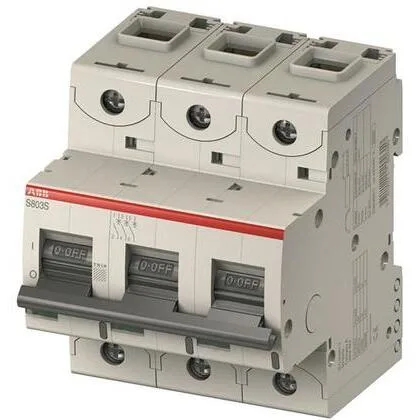
At 32 A per pole on a 230 V AC system, this breaker handles branch circuits feeding moderate motor or inductive loads without tripping on the initial surge, then clears a fault fast when it matters.
That's the key spec for anyone wiring motor circuits: a 7.5 kW three-phase motor on a 32 A D-curve MCB will see the startup current (typically 6–8× FLA) without the breaker opening, but a hard short downstream will clear in under 10 ms. The 3-pole configuration is standard for three-phase 230 V AC distribution — one pole per phase, common trip, so a fault on any phase opens all three simultaneously.
The 3-pole format takes up three module widths (about 54 mm total), so factor that into your rail layout and fill calculations. For a commissioning engineer: the breaker's toggle handle extends through the door cutout if you're using a rotary handle operator; verify the door cutout matches the S803N handle profile before drilling. For an MRO planner: keep one on the shelf for a 32 A motor branch or a lighting distribution subfeed — the D curve is the right call for any load that draws a hard startup surge.