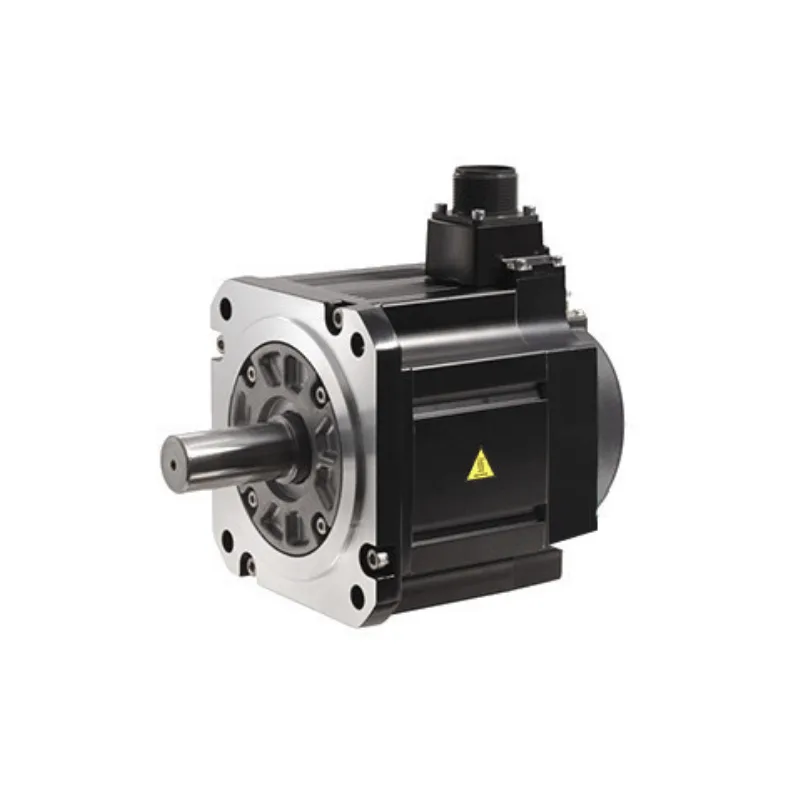
1.0 kW servo with holding brake for vertical-axis or high-hold applications
The HG-SN102BJ-S100 is a 1.0 kW servo motor from Mitsubishi's HG-SN series, rated for 4.77 N·m continuous torque at 2000 r/min base speed, with a maximum speed of 3000 r/min and an instantaneous permissible speed of 3450 r/min. The built-in electromagnet brake holds the load when power is removed — essential for vertical-axis stages, Z-axis robot arms, or any application where the load must not drift on power loss. The oil seal (J suffix) protects the shaft output from lubricant ingress in gearbox-coupled installations. Rated current draws 5.6 A continuous, with a 17 A peak for acceleration and deceleration transients. The power rate at continuous rated torque is 16.5 kW/s — a measure of how quickly the motor can accelerate a load, directly affecting cycle time in pick-and-place or indexing moves.
IP67 enclosure and ambient limits for machine integration
The motor is totally enclosed, naturally cooled, and rated IP67 — the housing and shaft seal resist dust ingress and temporary immersion, making it suitable for washdown zones, food processing lines, or outdoor cabinet installations where coolant mist or wash spray is present. No fan means no additional noise or filter maintenance, but the 40 °C upper ambient limit must be respected; above that, torque derating applies. Vibration rank V10 and vibration resistance of 24.5 m/s² in X and Y axes confirm the motor can tolerate the shock and vibration typical of machine-tool spindles and conveyor drives without bearing or encoder degradation. The altitude limit of 2000 m means above that elevation, the thinner air reduces natural convection cooling — factor in derating for high-altitude installations.
Inertia matching and tuning constraints
The recommended load-to-motor inertia ratio is 15 times or less. Exceeding this ratio makes the servo loop harder to stabilize — the proportional and integral gains must be reduced, which lengthens settling time and can cause overshoot or oscillation on position moves. For high-ratio loads (e.g., a large rotary table driven through a reduction gear), a larger-frame motor or a two-inertia notch filter in the drive is needed. Insulation class 155 (F) means the winding insulation withstands a 155 °C hot-spot temperature — adequate for the 40 °C ambient plus the internal temperature rise from continuous rated current. The IP67 sealing also traps heat; ensure the mounting surface or any auxiliary cooling (if used) keeps the winding temperature within the F-class limit during peak torque moves.