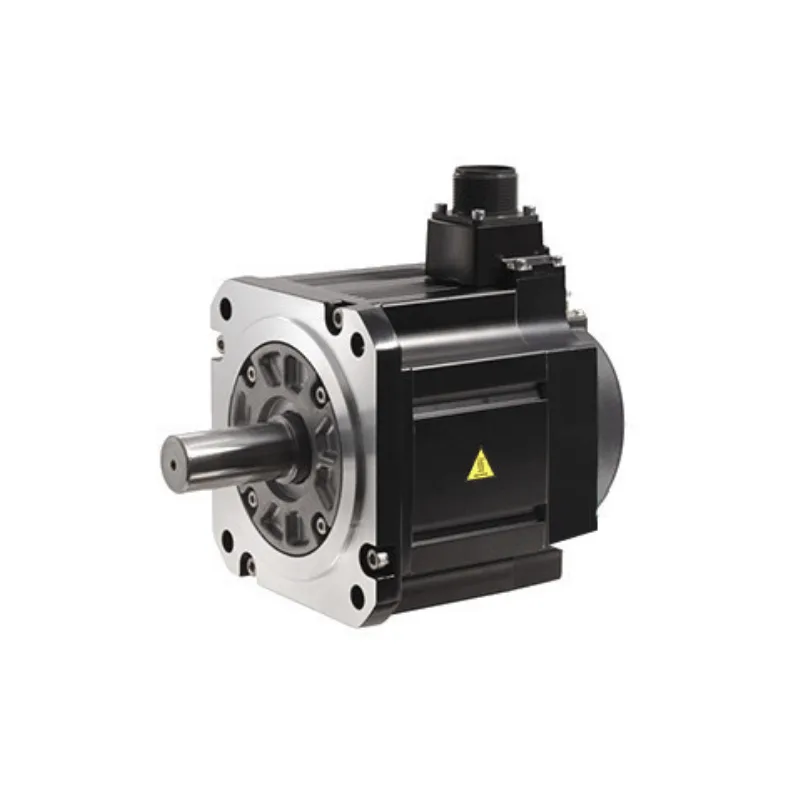
The HG-SN52BJ-S100 is a 0.5 kW servo motor from Mitsubishi's HG-SN series, rated for 2.39 N·m continuous torque at 2000 r/min, with a maximum speed of 3000 r/min and an instantaneous permissible speed of 3450 r/min. The 2.9 A rated current and 9.0 A peak current define the drive sizing — the amplifier must supply that peak for acceleration profiles. Insulation class 155 (F) means the winding withstands a 155 °C hot-spot temperature, standard for servo motors in industrial ambient conditions up to 40 °C. The 'B' in the model code indicates an integrated electromagnet brake, and the 'J' means an oil seal is installed on the output shaft. That makes this unit suited for vertical-axis applications where holding torque is needed at power-off, and for environments where lubricant ingress along the shaft is a concern. The brake is factory-fitted and wired through the motor connector — no separate brake power supply to size, but verify the brake release voltage matches the drive's holding brake output.
Environmental sealing and mounting constraints
Totally enclosed, natural cooling with IP67 rating means the motor body and shaft seal are protected against dust ingress and temporary immersion — suitable for washdown zones in food processing or machining coolant splash. The natural cooling (no external fan) limits duty cycle at low speeds; continuous torque at standstill is lower than the 2.39 N·m rating, which assumes the rated speed for self-ventilation. Ambient temperature must stay between 0 °C and 40 °C during operation, with storage from -15 °C to 70 °C. Vibration resistance is tested at 24.5 m/s² on X and Y axes, V10 rank — standard for general industrial mounting without additional dampening. Altitude is limited to 2000 m or less. Above that, derate the output torque due to reduced air density and cooling efficiency. The recommended load-to-motor inertia ratio is 15 times or less — exceeding that may cause tuning instability or require a larger motor frame. The power rate at continuous rated torque is 6.01 kW/s, a figure used for acceleration-time calculations in sizing software.