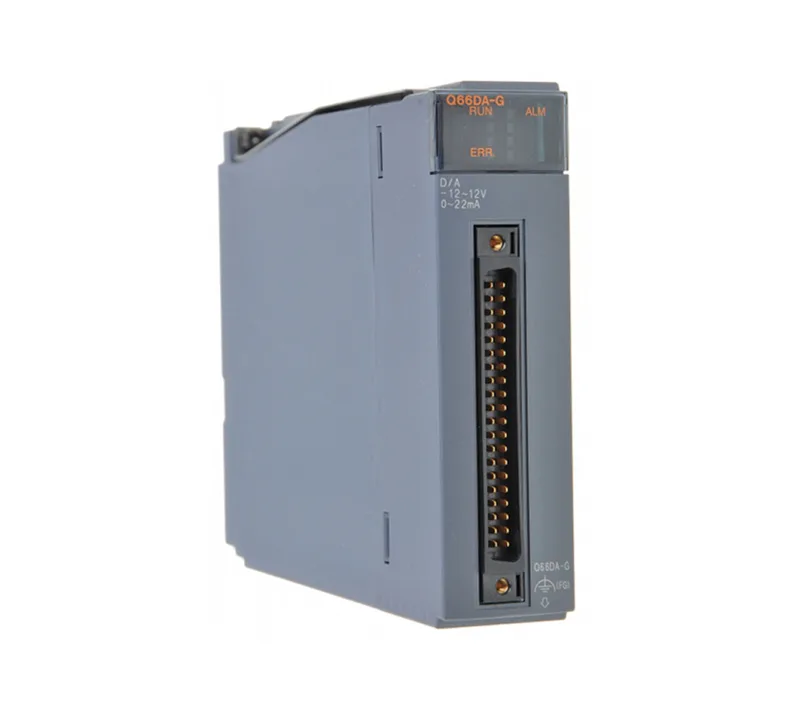
Six isolated analog outputs for precision control loops
The Q66DA-G is a six-channel isolated D/A converter for the Mitsubishi Q Series PLC rack. Each of the six analog output points runs its own signal path with channel-to-channel isolation, so a short on one loop doesn't pull down the other five — critical when you're mixing 4-20 mA transmitters and ±10 V drives on the same card. Resolution runs 16-bit signed binary with three selectable modes: normal mode spans -4096 to 4095, high-resolution mode goes to -12288 to 12287 or -16384 to 16383. The high-resolution mode gives you roughly 0.3 mV per LSB on a ±10 V span — enough for servo valve positioning or load cell trim without an external signal conditioner. Conversion speed is 6 ms per channel. That's 36 ms for a full six-channel update cycle — fast enough for most process loops (temperature, pressure, flow) but not for high-speed motion axes. If you're closing a servo loop at 1 kHz or faster, this module isn't the right fit.
Power budget and wiring constraints
The module draws 0.62 A from the 5 V DC backplane rail. On a fully loaded Q Series rack with multiple analog cards, that 620 mA adds up — check your base unit's 5 V supply capacity before slotting this in. External loop power requires 24 V DC at +20%/-15%, which is standard for industrial 24 V supplies but worth noting if your panel runs a regulated 24 V rail at the tight end. Wiring lands on a 40-pin connector. The mating half is the A6CON4, sold separately. Accepts 0.3 mm² wire (AWG #22) — fine for signal runs inside the cabinet but undersized for long cable pulls over 50 m where voltage drop in the loop becomes a factor. The analog output voltage range is -12 to 12 V DC with an external load resistance of 1 kΩ to 1 MΩ. That bipolar swing covers both unipolar (0-10 V) and bipolar (±10 V) actuator types. If your valve positioner expects 4-20 mA, you'll need an external I/V converter resistor across the output terminals.