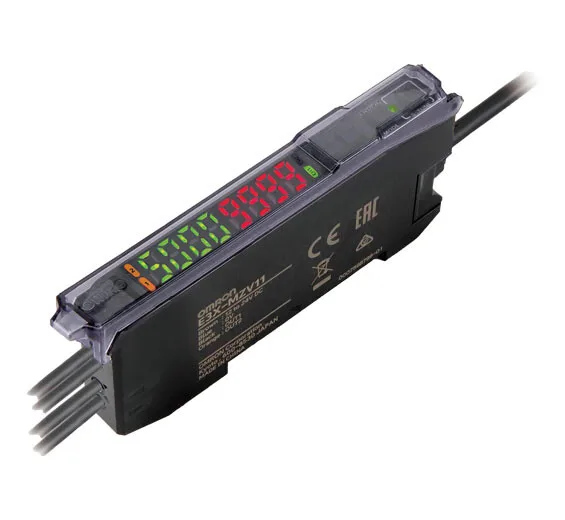
PNP output and selectable operation for PLC integration
The E3X-ZV9 delivers a PNP output, which sources current to the PLC input — the standard for most modern controllers. If your input card expects a sinking (NPN) signal, this amplifier requires a level shifter or a different model. Operation is selectable between L-ON (light-on) and D-ON (dark-on) without rewiring. This lets you invert the logic at the amplifier rather than reprogramming the PLC, which saves time during commissioning or when swapping between retro-reflective and thru-beam fiber heads.
Supply voltage and detection features for stable sensing
Runs on 12-24 VDC, matching the standard control voltage found in most industrial panels. The wide tolerance means it stays within regulation even on a lightly loaded bus that sags under motor inrush. Power tuning and auto threshold compensation adjust the gain and switching threshold automatically as the fiber lens or target surface changes — this reduces false trips from dust buildup or target reflectivity drift over a shift. The amplifier is designed for challenging print mark detection, where contrast between the mark and background is low. The red LED light source and digital processing handle the marginal signal that a basic analog amplifier would miss.
Timer, differential, and external input expand application flexibility
A built-in timer provides on-delay, off-delay, or one-shot output, which can filter out brief target passes or stretch a pulse for a slow PLC scan cycle. Differential operation compares two fiber heads (one reference, one sensing) to detect small changes in transmitted light — useful for detecting clear labels on a transparent web or liquid level in a sight glass. An external input accepts a teaching or trigger signal from the PLC, allowing remote sensitivity adjustment or synchronized gating without opening the panel.
Mature lifecycle and sourcing posture
The wire-saving connector reduces the number of individual terminations at the amplifier, which cuts panel wiring time and eliminates a common failure point (loose screw terminals on the sensor head).