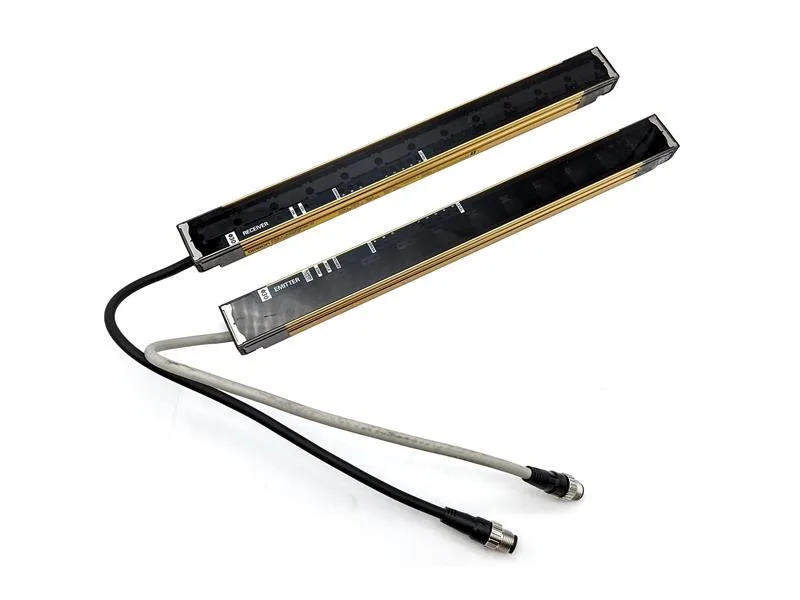
What this light curtain does
The Omron F3SJ-A0380P25-TS is a Type 4 safety light curtain from the F3SJ-A series, built for hand protection per IEC 61496. Its 25 mm detection capability means it catches fingers reaching through the field, not just a whole hand — that's the difference between a pinch-point guard and a full-body barrier. The 380 mm protective height and 0.2 m to 9.0 m operating range cover a typical hazard zone entry on a press, robot cell, or conveyor infeed.
Detection capability of 25 mm is the spec that decides whether this curtain replaces a physical guard or just supplements it. At 25 mm, it qualifies as finger-protection class per IEC 61496-2, so it can be the primary safeguarding on a machine where a 14 mm curtain would be overkill and a 30 mm curtain would miss the hazard. The 19 beams at 20 mm pitch give you the 380 mm protective height — that's the vertical zone the curtain actually covers, not the emitter length. The 0.2 m minimum range means it works close to the machine frame; the 9.0 m maximum covers a wide cell entry. IP65 rating means the emitter and receiver are dust-tight and protected against water jets — suitable for washdown environments in food processing or wet machining, but not for submerged or high-pressure spray (that would need IP67 or IP69K). Blanking and muting functions are built in — blanking lets you ignore a fixed object (like a fixture) inside the field without disabling the whole curtain; muting lets the curtain temporarily override during a material pass (e.g., a pallet moving through). These are configurable via the controller, not hardwired.
Where it goes on the line
This class of safety light curtain is the standard access guard on automated assembly stations, press brakes, packaging machines, and robot work cells. It mounts vertically or horizontally at the hazard opening, with the emitter and receiver aligned across the access point. The 24 VDC supply is typical for safety circuits tied to a safety relay or safety PLC.