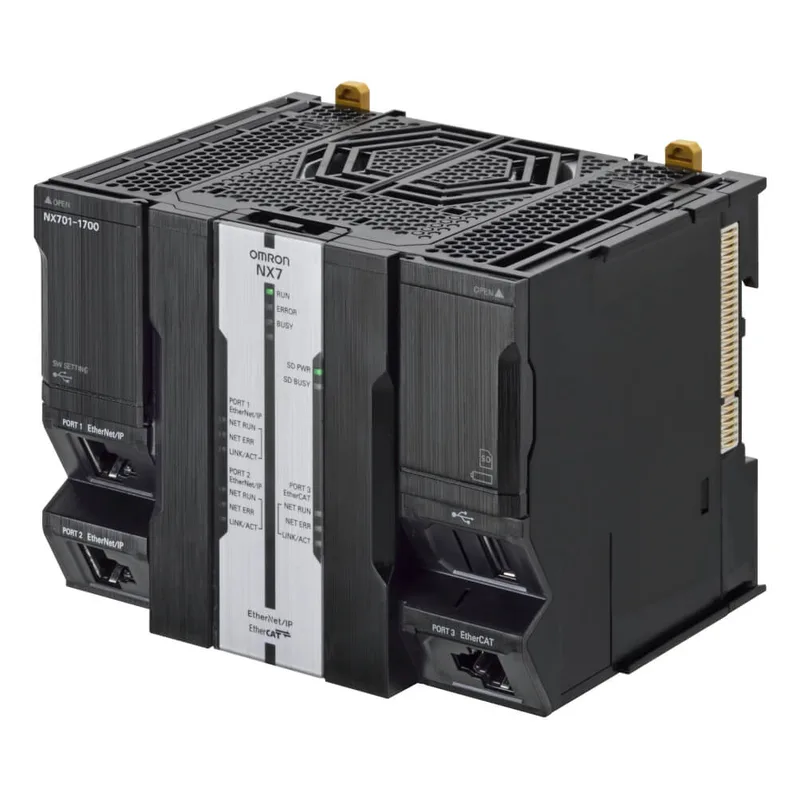
What the NX7 series is and where it sits in a machine
The NX701-1700 is Omron's high-end motion controller in the NX7 family — it combines sequence control and motion control in a single CPU and adds an OPC-UA server for direct IIoT integration without a middleware gateway. Communication ports are EtherCAT Master, EtherNet/IP and Ethernet TCP/IP, so the controller can sit on a modern automation network while also driving distributed I/O over the NX I/O Bus. Because it is EtherCAT Master on the same hardware that handles sequence logic, it eliminates the separate motion module some architectures require — a BOM consolidation point for multi-axis OEM designs and large-cell retrofits alike.
256 axes and what that ceiling actually means
Maximum of 256 axes — synchronous or virtual — puts this at the upper end of the NX7 range and well beyond mid-range PLC-based motion controllers. The 0.125 ms primary task cycle time sets the fastest scan the CPU can guarantee under load; if your axes require tighter interpolation loops than that, a dedicated servo drive with its own inner-loop position control is the right split regardless of what the controller can command. At the 256-axis ceiling, the real constraint becomes I/O bus bandwidth and EtherCAT network topology, not controller CPU.
Memory that governs what you can load and log
80 MB program memory and 260 MB variables memory give the NX701-1700 substantial room for large axis databases, recipe archives, and OPC-UA tag buffers without forcing a mid-project memory audit. The 260 MB variables pool is especially relevant if the application logs production data locally or holds multi-product recipe sets — the kind of requirement that appears in food-and-beverage and packaging lines where product changeovers are software-driven rather than hardware-swapped.
Physical and logistics specs that drive procurement
Unit weight is listed at 0.88 Kg; shipping weight is 3 Kg — the difference is packaging and any accessories included in the box. The 0.88 Kg figure is what governs DIN-rail loading and cabinet weight budgets on an existing frame. The NX701-1700 ships as an active Omron part; estimated lead time is typically 1 to 10 working days, which means it is stocked-to-order against an RFQ rather than a same-day ship item — plan accordingly for a line-down scenario if you do not hold a spare.
What the NX I/O Bus integration means for the panel
The NX701-1700 drives the NX I/O Bus — a distributed I/O architecture that uses the same fieldbus backbone as the EtherCAT network. On the NX I/O Bus, I/O modules snap onto the same backplane segment and inherit their address mapping from the controller's configuration tool, so adding a safety I/O module or an additional digital block does not require a separate fieldbus node. If your current design uses a different I/O bus family — legacy parallel I/O, CC-Link, or a competing distributed I/O system — the NX701-1700 will not drop in without a fieldbus gateway or a rewire of the I/O tier; this is an architectural change, not a pin-compatible substitution.