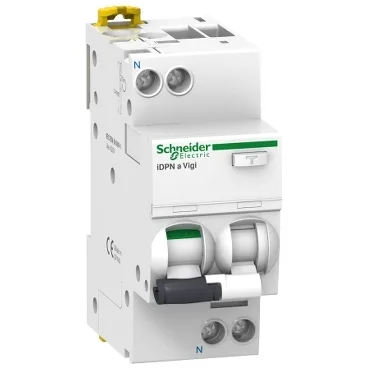
The A9D44616: The C-curve means magnetic tripping happens between 5 and 10 times the rated current (80 to 160 A), which suits mixed resistive and moderate-inductive loads like lighting circuits, small motorised valves, and general socket outlets. The 300 mA earth-leakage threshold is a common choice for distribution sub-circuits where personnel protection (30 mA) is not required — think fixed equipment, water heaters, or industrial socket banks fed through an upstream 30 mA RCD. Breaking capacity is 4.5 kA at 230…240 V AC, 50 Hz, per EN/IEC 61009-2-1. That is the standard domestic and light-commercial fault level in many markets; if your panel's prospective short-circuit current exceeds 4.5 kA, you need to step up to a higher-rated device or add a current-limiting upstream MCB.
Clip-on DIN rail mount, 36 mm wide (4 x 9 mm pitches). Terminals accept 1…16 mm² solid or 1…10 mm² flexible (with or without ferrule), with a 15 mm strip length and 2 N·m tightening torque. IP20 on the body, IP40 inside a modular enclosure. Pollution degree 3 — the unit handles conductive dust and condensation typical of industrial control rooms. Local signalling shows ON, OFF, and fault-trip status through the toggle — useful for a field tech walking a row of RCBOs to spot a tripped unit without touching anything. The toggle itself is the control type; no push-to-test button on this variant.
The Acti9 range is Schneider's current-generation modular DIN-rail family, so this RCBO shares its platform with the rest of the iDPN Vigi sub-series. If you are standardising on Acti9 for a new panel build, the A9D44616 fits the same busbar system, same comb, same enclosure cut-outs as the rest of the range.