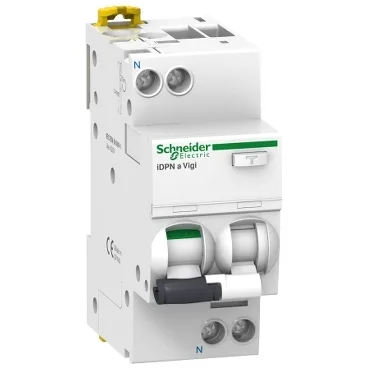
It carries a 20 A rated current with a B tripping curve (3–5 x In magnetic trip), and integrates 30 mA earth-leakage protection.
Rated breaking capacity is 4500 A Icn at 220–240 V AC, 50 Hz, per EN/IEC 61009-2-1. That's the standard domestic and light-commercial fault level in most European installations — it interrupts a bolted fault up to 4.5 kA without welding the contacts. For selectivity with an upstream MCB, the limitation class 3 rating (also per EN/IEC 61009-2-1) means it lets through less energy, helping the upstream device stay closed on a downstream fault. That's a real coordination advantage when you're stacking breakers on a distribution board.
Terminals accept 1–16 mm² rigid or 1–10 mm² flexible (with or without ferrule), strip length 15 mm, tightening torque 2 N·m. That's enough for a 4 mm² outgoing cable on a 20 A circuit, which is typical for a ring final or a radial socket circuit. IP20 on the body, IP40 inside a modular enclosure — fine for a distribution board, not for a washdown area.