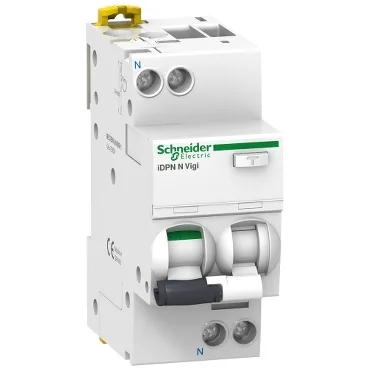
Rated at 16 A with a B-curve magnetic trip (3–5 x In), it handles general-purpose resistive and light inductive loads in final circuits — lighting, socket outlets, small appliances. The integrated earth-leakage protection trips at 300 mA, which covers basic fault protection but is not suitable for personal shock protection (30 mA required for that). Breaking capacity is 6000 A Icn at 220–240 V AC, 50 Hz, certified to EN/IEC 61009-2-1. That's the standard domestic and light commercial fault level; for industrial panels with higher prospective fault current, you'd step up to a 10 kA or 25 kA device.
The thermal-magnetic trip unit combines a bimetal strip for overload protection (16 A continuous) and a solenoid for short-circuit (B-curve: 48–80 A instantaneous). This is the standard mechanism for MCB/RCBO protection — no electronics to fail, no auxiliary power needed. Terminals accept 1–16 mm² rigid or 1–10 mm² flexible, with a tightening torque of 2 N·m. Strip length is 15 mm. Rated for 20,000 electrical and 20,000 mechanical cycles. In a residential or light commercial distribution board where the RCBO is operated infrequently (a few times a year for testing), that's effectively a lifetime rating. In a high-cycle application like frequent switching of a machine, you'd derate or use a contactor. The tropicalisation treatment (class 2 per IEC 60068-1) adds corrosion resistance for humid environments.