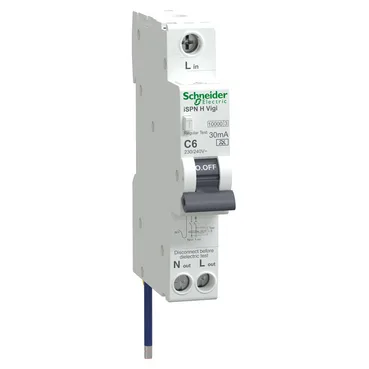
The 10 kA breaking capacity at 230/240 V AC (Icn per AS/NZS 61009.1) is sized for residential and light commercial sub-distribution where the prospective fault current stays under that threshold.
Rated at 6 A with a C-curve magnetic trip threshold of 5 to 10 times In, so it clears moderate inrush from motorized loads and fluorescent ballasts without nuisance tripping — but the 6 A frame limits the connected load to roughly 1.4 kW resistive or 1.1 kW motor (230 V). The integrated 30 mA residual-current element covers personnel protection (30 mA is the standard threshold for indirect-contact protection per AS/NZS 3000). Breaking capacity of 10 kA at 230/240 V AC 50 Hz places it in limitation class 3, meaning it limits let-through energy enough to coordinate with a downstream 4.5 kA MCB in most domestic panels. Pollution degree 2 and tropicalisation level 2 confirm it for normal indoor environments with non-condensing humidity up to 95 % at 55 °C. Terminals accept up to 25 mm² rigid upstream and 16 mm² rigid downstream; tightening torque is 3.5 N.m upstream, 2 N.m downstream. Strip length 14 mm upstream, 13 mm downstream — a detail that matters when terminating in a crowded enclosure. The toggle is padlockable (Ø 4 mm padlock) for lockout/tagout during maintenance.
Width is 18 mm (2 x 9 mm pitches) on a 45 mm grid distance. Clips onto standard DIN rail (35 mm) with the neutral on the left. IP20 finger-safe terminals are acceptable in an enclosed distribution board but not for wet or dusty locations. Electrical durability is 6000 cycles; mechanical durability 10 000 cycles — adequate for a final-circuit breaker switched infrequently.