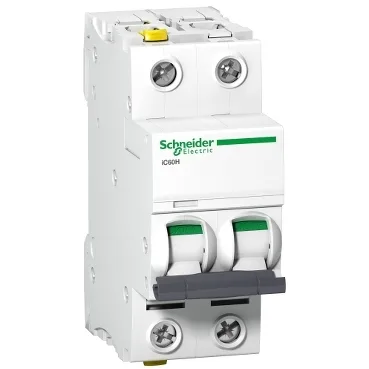
The A9F06220 is a 20 A B-curve miniature circuit breaker from the Schneider Electric Acti9 iC60H series, 2-pole (2P) construction. The 20 A rating per pole governs the continuous load it can carry without thermal tripping under normal conditions. Breaking capacity is the headline differentiator here: 42 kA Icu at 12-133 V AC, 30 kA Icu at 220-240 V AC, 15 kA Icu at 380-415 V AC, and 10 kA Icu at 440 V AC (all per EN/IEC 60947-2). That places it in the highest category for mains-connected equipment — suitable for main distribution boards where the breaker sees the full utility-side surge environment, not just downstream sub-panels. The IP20 finger-safe terminals are standard for enclosed panel mounting; the DIN rail mount (36 mm width, 4 x 9 mm pitches) snaps into any standard 35 mm rail.
Dual standard compliance and isolation suitability
This MCB is certified to both EN/IEC 60898-1 (the domestic-standard for MCBs) and EN/IEC 60947-2 (the industrial-standard for low-voltage switchgear). The practical difference: 60898-1 governs the Icn rating (10 kA at 400 V) and is the basis for domestic-type approval marks; 60947-2 governs the Icu ratings and the utilisation category A, which allows the breaker to be used in industrial distribution where higher fault currents and different coordination requirements apply. The breaker is also marked as suitable for isolation per both standards — meaning when toggled off, it provides a visible air gap that meets the isolation requirements for safe maintenance access.
The double terminals (top and bottom) accept 1-25 mm² rigid or 1-16 mm² flexible conductors. Wire stripping length is 14 mm for both top and bottom connections. The thermal-magnetic trip unit provides both overload protection (thermal bimetal) and short-circuit protection (magnetic solenoid) in one package. Earth-leakage protection requires a separate Vigi iC60 block — not integrated into this base MCB.
Environmental and durability ratings
Relative humidity tolerance is 95 % at 55 °C. The limitation class is 3 per EN/IEC 60898-1, meaning it limits let-through energy (I²t) to a level that protects downstream cables and equipment within its rated breaking capacity.