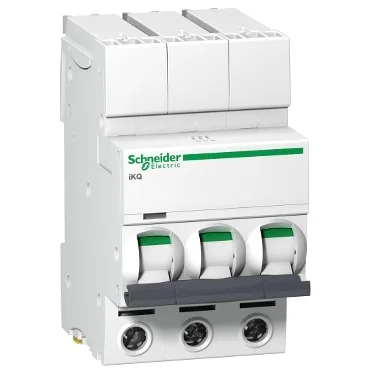
The Schneider Electric A9F57325 is an Acti9 IKQ miniature circuit breaker — 3-pole, 25 A rated current, C-curve, with a 10 kA Icn breaking capacity at 415 V AC per EN 60898-1. For a panel fed from a typical 400 V distribution transformer, that Ics covers most downstream fault scenarios short of a direct bolted fault at the main bus.
The C-curve (magnetic trip at 5–10 × In) means this breaker is sized for inductive loads — motor starters, contactor coils, small transformers — where the inrush current can hit 5–8 times the steady-state rating without nuisance tripping. At 25 A, that magnetic threshold sits between 125 A and 250 A. The thermal-magnetic trip unit handles the overload side; the thermal bimetal tracks the 25 A continuous rating, so it will hold a 25 A resistive load indefinitely in a 30 °C ambient but trip on a sustained 32 A overload within the standard time-current curve. The 440 V insulation voltage (Ui) and 415 V operational voltage (Ue) match standard European 400/415 V three-phase networks.
The 54 mm width (6 x 9 mm pitches) is the standard 3-pole MCB footprint; it occupies three modular spaces on the rail. Terminals accept 1–25 mm² rigid or 1–16 mm² flexible conductors at the bottom, with a tightening torque of 2 N·m. Strip length is 14 mm for the bottom connection. IP20 rated, so it is intended for enclosure use only — not for wet or washdown environments. The toggle actuator provides local on/off control, and the trip indicator gives visual confirmation of a fault trip. Padlockable for lockout/tagout procedures.
Limitation class 3 per that standard means it limits through-energy during a short-circuit to a level that protects downstream equipment better than a class 1 or 2 breaker. The 10,000-cycle electrical durability and 20,000-cycle mechanical durability are typical for a DIN-rail MCB in normal switching duty — not a daily-switch application, but fine for occasional isolation and fault clearing.