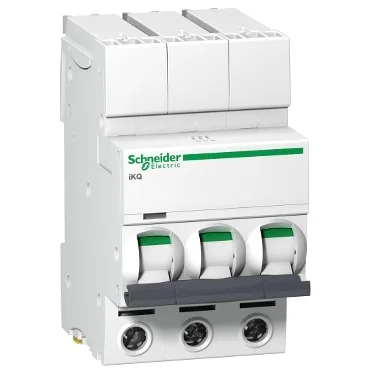
The Schneider Electric A9F57363 is a 3-pole Acti9 IKQ miniature circuit breaker rated at 63 A with a C-curve magnetic trip threshold of 5 to 10 times In. The 10 kA Icn breaking capacity at 415 V AC (EN 60898-1) means it can safely interrupt a fault current up to 10,000 A without welding its contacts or failing — that's the standard rating for most commercial and light industrial distribution boards. The C-curve is the default for general-purpose loads: lighting banks, small motor circuits, and resistive heating where the inrush isn't extreme. It trips magnetically between 5x and 10x In, so a 63 A breaker will hold through a 315 A to 630 A surge for a few cycles before clearing — enough for most motor-starting and capacitor-switching events. If your load has a high inrush (large transformers, welding plant), you'd want a D-curve; if it's purely resistive, a B-curve gives faster protection. Thermal-magnetic trip technology means the bimetal element handles sustained overloads (the thermal side) while the solenoid handles short-circuits (the magnetic side). No electronic trip unit to fail or need auxiliary power — it's a passive, self-powered device that works as long as current flows through it.
At 54 mm wide (6 x 9 mm pitches), it occupies three standard module positions in a distribution board. The toggle actuator gives clear visual indication of the contact position, and the trip indicator flags when the breaker has tripped on fault rather than being manually switched off. Wire stripping length is 14 mm. Pollution degree 2 (normal factory environment, non-conductive dust).
The breaker is designed to EN/IEC 60898-1, which is the harmonized European standard for miniature circuit breakers. No earth-leakage protection integrated — this is a straight MCB, not an RCBO. That's typical for a molded-case MCB — good for years of regular switching in a panel, but not intended for frequent load-break duty like a contactor.