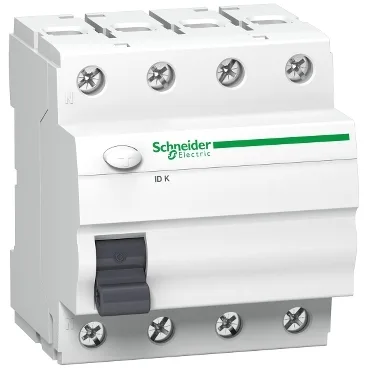
It carries a 40 A rated current and 100 mA earth-leakage sensitivity, Type AC, with instantaneous trip — no intentional delay, so it clears ground faults as fast as the waveform lets it. That 100 mA sensitivity is typical for general-purpose protection where you want to catch leakage through degraded insulation without nuisance-tripping on normal cable capacitance.
The 40 A continuous rating matches a typical submain or group feeder. The 100 mA sensitivity sits between the 30 mA used for personal shock protection and the 300 mA used for fire prevention — it's the middle ground for protecting equipment and reducing unwanted trips on circuits with some natural leakage. The instantaneous time delay means it trips within the waveform cycle — no coordination with downstream selective RCCBs unless they are time-delayed (S-type). Rated breaking and making capacity is listed as Idm 500 A and Im 500 A — sufficient for clearing a solid fault to earth on a 40 A circuit, but this is not a short-circuit interrupting device. Upstream protection (MCB or fuse) must handle the prospective fault current. The RCCB is voltage-independent for its tripping mechanism, meaning it detects leakage and trips even if the phase voltage collapses — a useful trait for fault conditions where the supply is compromised.
Clip-on mounting onto a DIN rail, 72 mm wide (4 module pitches at 18 mm each). Terminals accept Biconnect top or bottom: 1-35 mm² rigid or 1-25 mm² flexible. Wire stripping length is 14 mm, tightening torque 3.5 N.m. IP20 on the body, IP40 inside the modular enclosure — fine for a clean indoor distribution board, not for washdown areas. Pollution degree 2 (non-condensing, typical for controlled environments).