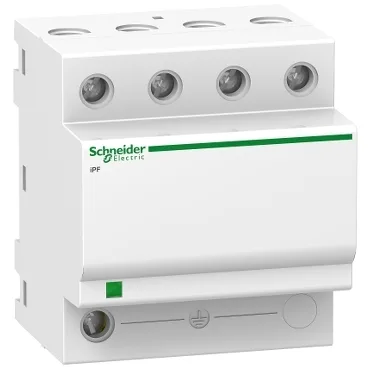
The Schneider Electric A9L15593 is a Type 2 surge arrester from the Acti9 iPF range, designed for distribution networks in small commercial installations. It uses MOV technology to clamp surge voltages on a 230/400 V AC TN-C system, with a nominal discharge current of 5 kA per mode and a maximum of 20 kA per mode (L/PE and N/PE). The total discharge capacity reaches 80 kA across all four poles. It clips onto a DIN rail (snap-on mounting) and occupies 8 modules of 9 mm pitch — that's 72 mm of panel width, with a depth of 69 mm and height of 81.4 mm. The tunnel-type terminals accept 2.5 to 35 mm² conductors, torqued to 2.5 N·m.
If you need a drop-in replacement, the closest functional peer in the Acti9 iPF family shares the same Type 2 MOV design and 4-pole form factor; the key difference to verify is the maximum continuous operating voltage (Uc) and the protection level (Up) for your specific earthing system.
The 340 V Uc (maximum continuous operating voltage) means this arrester can sit on a 230/400 V TN-C system without clipping the line voltage during normal operation. The protection level Up is under 1.1 kV — that's the let-through voltage the downstream equipment sees during a surge event. For sensitive electronics, verify that 1.1 kV is within the impulse withstand of your load side. The IK03 impact rating (per IEC 62262) means the enclosure withstands 0.35 J — enough for accidental tool contact during panel work, but not a heavy blow. The operating temperature range is -25 to 60 °C, with storage from -40 to 85 °C; the relative humidity limit of 5 to 90 % covers most indoor panel environments.