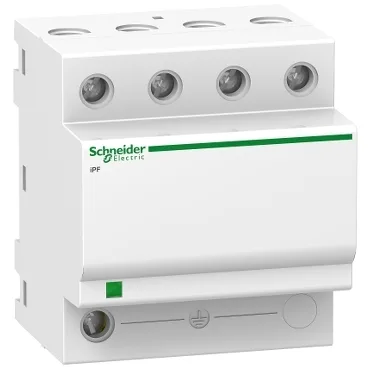
The Schneider Electric A9L15596 is an Acti9 iPF8 modular surge arrester — a Type 2 + 3 device, meaning it handles both main distribution board surges (Type 2, up to 8 kA impulse) and downstream equipment-level protection (Type 3, open-circuit voltage 10 kV). It uses MOV (metal-oxide varistor) technology and is rated for 230/400 V AC (+/- 10 %) at 50/60 Hz. The 4-pole configuration (, L2, L3, N) suits TN-C earthing systems, with a maximum continuous operating voltage of 340 V common mode between each line and PE, and between N and PE.
Nominal discharge current (In) is 2.5 kA per mode (L/PE and N/PE) — this is the current the arrester can safely divert repeatedly during a standard surge event. Maximum discharge current (Imax) is 8 kA per mode, covering rare high-energy strikes. Total discharge current (Itotal) across all modes sums to 30 kA, which tells you the arrester's overall energy-handling capacity in a multi-pulse event. The voltage protection level (Up) stays below 1.1 kV in type 3 mode (N/PE), which is tight enough to protect most sensitive electronics downstream — think PLC power supplies or control transformers.
Clip-on DIN rail mount, 72 mm wide (4-pole, 8 modules of 9 mm pitch), 69 mm deep. Tunnel terminals top and bottom accept 2.5 to 35 mm² conductors — fine for downstream distribution cabling. Torque to 2.5 N·m. Ambient operating range -25 to 60 °C, storage -40 to 85 °C, with relative humidity 5–90 %. The white RAL 9003 housing matches standard Acti9 enclosures.
Designed and tested to EN 61643-11 and IEC 61643-11 — the core standards for low-voltage surge protective devices (SPDs). Carries quality marks NF, OVE, and KEMA-KEUR, covering French, Austrian, and Dutch certification bodies. IK03 impact rating per IEC 62262 means it withstands 0.35 J impact — sufficient for enclosed panel environments.