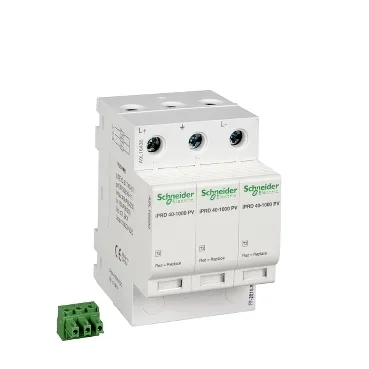
The MOV + GDT technology (metal-oxide varistor plus gas discharge tube) gives it a response time of ≤25 ns, which means it clamps fast enough to keep a surge off sensitive DC bus electronics before the voltage rises past the equipment's impulse withstand.
Rated operational voltage (Ue) is 600 V DC ±10 %, but the maximum continuous operating voltage (Ucpv) reaches 840 V DC in differential mode (L+/L-). That 840 V figure is the one you check against your system's nominal DC bus voltage — if your array or battery bank runs at 800 V nominal, this arrester stays below its continuous limit and won't degrade prematurely. Common-mode protection (L+/PE and L-/PE) is rated at 600 V DC continuous. Nominal discharge current (In) is 15 kA; maximum discharge current (Imax) is 40 kA. The voltage protection level (Up) is under 2.8 kV for both differential and common modes. That Up figure tells you the maximum voltage the load sees during a surge — keep it below the equipment's rated impulse voltage (typically 4 kV for 600 V class gear) and you have coordination. The integrated disconnector (a thermal protection feature) separates the arrester from the circuit if the MOV reaches end of life, preventing a short. A white/red flag on the front gives local status; the volt-free contact (1 C/O, rated 0.25 A / 250 V AC) can signal remote monitoring.
Terminal tunnels accept 2.5 to 25 mm² rigid or 2.5 to 16 mm² flexible conductors; strip length is 14 mm, torque to 3.5 N·m.