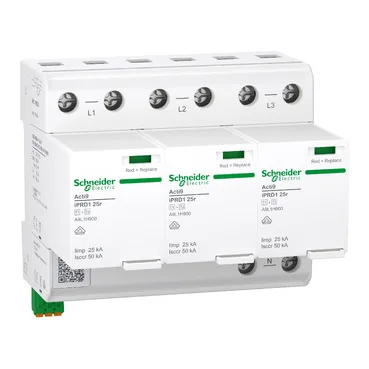
The Schneider Electric A9L1H325 is an Acti9 iPRD1 Type 1+2 surge arrester with a pluggable cartridge, built for electrical distribution network protection. It handles both direct lightning strikes (Type 1) and switching surges (Type 2) in a single device, which simplifies panel design and reduces the number of components on the DIN rail. Rated for a 25 kA impulse current per pole and a 50 kA short-circuit withstand, this 3-pole unit covers the main incoming supply in a TN-C earthing system. The <100 ns response time means it clamps transients before they propagate into downstream equipment — relevant for protecting sensitive electronics in control panels or PLC racks. Internally, it uses a MOV + GDT hybrid technology. The gas discharge tube handles the high-energy impulse, while the metal-oxide varistor absorbs the repetitive lower-energy surges. This pairing gives longer service life in dirty power environments compared to a MOV-only design.
Clip-on DIN rail mounting (EN 60715) — snaps onto the rail without tools, which saves panel-builder time. The housing is thermoplastic, white (RAL 9003), and measures 108.3 mm wide by 105 mm high by 86 mm deep. At 12 module pitches (9 mm each), it occupies a standard 12-M width in the distribution board. Power terminals accept 6–35 mm² solid/stranded or 6–25 mm² flexible cable; the earthing terminal goes up to 35 mm² solid. Strip lengths are 18 mm for power and earth, 10 mm for the remote-signal connection. Tightening torque on the power circuit is 4.5 N·m — use a torque screwdriver to avoid terminal damage in a vibrating panel. IK05 impact rating means it shrugs off the odd dropped tool during commissioning. Operating altitude goes to 4000 m without derating, so it works in high-altitude installations like mining sites or mountain substations.
Certified to IEC 61643-11:2011, EN 61643-11:2012, and EN 61643-11:2018/A11. Carries a VDE quality label, which is the relevant German market approval for this targeted-country listing (Germany). The associated fuse is gG 315 A — confirm coordination with the upstream protective device during panel design. Remote signalling is built in: a green flag for operating state, a red flag for fault indication. The signalling circuit handles 1 A at 250 V AC or 0.5 A at 24/48 V DC, so it can drive a panel lamp or PLC input directly. Relative humidity range is 5–95% — no special derating for damp environments.