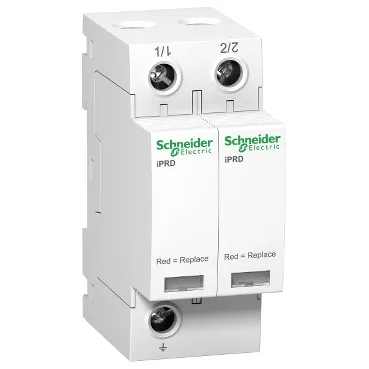
It clamps line-to-PE surges via a metal-oxide varistor (MOV) stage, rated for a nominal discharge current of 5 kA (L/PE) and a maximum discharge of 20 kA (L/PE). The protection level Up stays under 1.8 kV (L/PE), which keeps the let-through voltage inside the impulse withstand of most downstream equipment.
Voltage ratings and temporary overvoltage handling
Rated operational voltage is 230 V AC (±10 %) at 50/60 Hz, with a maximum continuous operating voltage Uc of 460 V (L/PE). The temporary overvoltage (TOV) withstand is specified: 337 V L/N for 5 seconds, and a safe failure mode at 1453 V L/PE for 200 ms — meaning the arrester will fail short-circuit rather than explode under a sustained high-voltage fault, which is critical for IT systems where the first fault doesn't trip the supply.
Clip-on DIN rail mounting, 36 mm wide (2-pole width), 90 mm deep, 70 mm tall — fits a standard 4-module pitch on the rail. Tunnel-type terminals accept 2.5 to 25 mm² rigid or 4 to 16 mm² flexible on both sides; tighten to 3.5 N·m. The remote-signalling contact (1 C/O, rated 0.25 A / 250 V AC) lets a PLC or DCS monitor arrester status without climbing the panel.
Short-circuit coordination and standards
The arrester must be paired with an upstream overcurrent device: either an iC60L 10 A curve C breaker (Icu 25 kA) or a gG fuse rated 40 A or 80 A (Isc 15 kA or 50 kA respectively). Its own short-circuit withstand is 5 kA at 415 V phase-to-phase. Compliance with EN 61643-11:2012 and IEC 61643-11:2011 is listed — the Type 2 classification means it's designed for the main distribution board, not the service entrance.