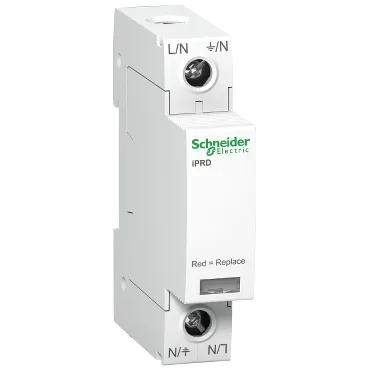
The Schneider Electric A9L40100 is an Acti9 iPRD40 Type 2 surge arrester with a pluggable MOV cartridge, rated for 230 V AC (+/- 10 %) at 50/60 Hz on TN-C and IT 230 V earthing systems. The 40 kA common-mode maximum discharge current (L/PE) and 15 kA nominal discharge current cover most service-entrance and sub-distribution panel surge requirements.
Type 2 per EN 61643-11:2012 and IEC 61643-11:2011 means this arrester is designed for the main or sub-distribution board, clamping switching transients and indirect lightning surges before they reach downstream equipment. The 350 V maximum continuous operating voltage (Uc) matches 230/400 V TN systems with up to +10 % steady-state tolerance. The temporary overvoltage withstand of 337 V for 5 seconds (L/N) and 1200 V for 200 ms (N/PE) in safe failure mode means the MOV can ride through a brief overvoltage without catastrophic failure — important for utility-switching events. The voltage protection level (Up) is under 1.4 kV, which keeps let-through voltage low enough to protect most IEC 60947-2-listed circuit breakers and contactors in the same panel.
Clip-on DIN rail mount (EN 60715). Tunnel terminals on both top and bottom accept 2.5 to 35 mm² conductors; tighten to 2.5 N·m. The 85 mm height and 69 mm depth are standard for Acti9 modular devices, so it aligns with adjacent MCBs and RCDs on the same rail. The white housing (RAL 9003) matches the rest of the Acti9 range.
Associated overcurrent protection
The manufacturer specifies several associated circuit breakers or fuses to back up the arrester: iC60H 40 A curve C (Icu 15 kA), iC60N 40 A curve C (Icu 10 kA), NG125H/N/L 40 A curve C (Icu 25–50 kA), or gG fuses up to 80 A. This lets the panel builder match the SCCR of the distribution board without oversizing the arrester branch. The iPRD40 itself does not include a disconnector — it relies on the upstream device for fault current interruption.