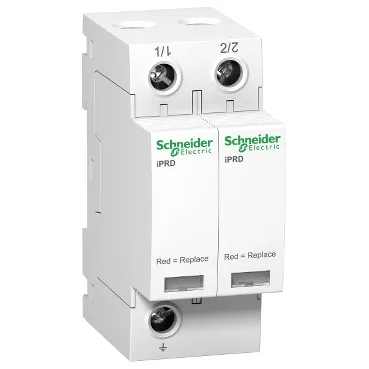
It's a 2-pole, MOV-based arrester rated 230 V AC (+/- 10 %) at 50/60 Hz, with a maximum continuous operating voltage (Uc) of 350 V common mode on both L/PE and N/PE paths. The headline numbers: 40 kA maximum discharge current (Imax) and 15 kA nominal discharge current (In) per the Type 2 test sequence. That means it handles direct lightning-induced surges up to 40 kA once, and repeatedly clamps 15 kA surges without degrading — the rating that governs coordination with downstream equipment. Protection level (Up) is under 1.4 kV common mode, which keeps let-through voltage low enough for most downstream switchgear and electronics to ride through without damage.
Clip-on DIN rail mount, 36 mm wide (4 x 9 mm pitches). Tightening torque 2.5 N·m. That's a standard panel footprint; fits alongside a 2-pole MCB in a distribution board. Comes with remote signalling contacts (1 C/O, rated 0.25 A / 250 V AC) for a panel lamp or PLC input to flag a failed cartridge. The signalling circuit voltage matches standard control voltages. Relative humidity 5 to 95 %. IK03 impact rating per IEC 62262 — tough enough for panel handling but not for direct mechanical abuse.
Coordination and associated breakers
The iPRD40r is designed to be paired with an upstream overcurrent protective device. Schneider lists compatible breakers: iC60H (40 A, curve C, 15 kA Icu), iC60N (40 A, curve C, 10 kA), NG125H (40 A, curve C, 36 kA), NG125L (40 A, curve C, 50 kA), NG125N (40 A, curve C, 25 kA), or fuses gG 63 A (15 kA) and gG 80 A (50 kA). Pick the one that matches your system's fault level. Temporary overvoltage (TOV) withstand: 337 V L/N for 5 seconds (withstand), 1200 V N/PE for 200 ms (safe failure mode). That covers most utility switching events without blowing the cartridge prematurely.