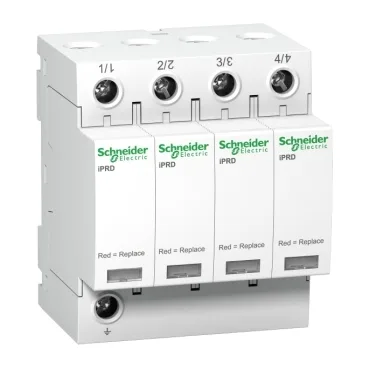
The Schneider Electric A9L40421 is a Type 2 surge arrester from the Acti9 iPRD range, built for distribution networks. The 40 kA maximum discharge current (Imax) per mode (L/PE and N/PE) tells you it can handle a direct lightning strike at the service entrance without failing short; the 15 kA nominal discharge current (In) is the rating for repeated switching surges it sees daily. Both are common-mode ratings, meaning the protection path is from each live conductor to earth, which is exactly what an IT earthing system (the listed earthing type) demands — no neutral-to-earth bond at the transformer, so surges must be diverted phase-to-ground. The 230/400 V AC rated operational voltage (Ue) with ±10 % tolerance covers standard three-phase low-voltage networks at 50/60 Hz. The maximum continuous operating voltage (Uc) is 460 V L/PE — this is the steady-state voltage the MOV can sit across without degrading. The temporary overvoltage (TOV) withstand is 337 V L/N for 5 seconds before the arrester must safely fail; at 1455 V L/PE it goes into safe failure mode in 200 ms, which means it will not explode or cause a fire if a phase-to-earth fault occurs upstream. The protection level (Up) is under 2.2 kV for the N/PE mode. This is the voltage that appears at the protected equipment terminals when the arrester fires — the lower this number, the better the clamping. For a Type 2 device at this discharge level, sub-2.2 kV is typical and adequate for most industrial electronic loads with a basic impulse withstand of 2.5 kV or higher.
The housing is 72 mm wide (4 module pitches at 18 mm each), 85 mm tall, 69 mm deep — fits standard distribution boards. Tunnel-type terminals accept 2.5 to 25 mm² rigid or 4 to 16 mm² flexible (with or without ferrule). The 9 mm pitch count of 8 confirms it occupies 8 of those pitches, consistent with the 4P + signalling contact footprint. Remote signalling is built in — a 1 C/O (changeover) volt-free contact rated 0.25 A / 250 V AC. This lets a PLC or building management system monitor the arrester's health (cartridge status) without running power through the MOV path. The signalling circuit is separate from the main discharge path, so you can wire it to a 24 V DC digital input if you prefer, as long as you stay within the contact rating.
Coordination and back-up protection
The A9L40421 has a short-circuit withstand of 5 kA at 415 V phase-to-phase. To reach higher fault levels, it must be backed by an upstream overcurrent device. Schneider specifies several associated devices: a gG 63 A fuse (Icu 15 kA), gG 80 A fuse (50 kA), or a range of iC60 / NG125 circuit breakers at 40 A curve C with Icu from 10 kA to 50 kA. This is not optional — the arrester's own SCCR is limited, and the back-up device must be selected to clear a fault before the MOV fails catastrophically. For a 40 A curve C MCB, the coordination is designed so the breaker trips before the arrester reaches its thermal limit.
Relative humidity 5 to 95 % non-condensing. Maximum operating altitude 2000 m. Standards compliance: EN 61643-11:2012 and IEC 61643-11:2011 — these are the harmonised European and international standards for low-voltage surge protective devices (SPDs), covering testing, classification (Type 2), and performance requirements. The white housing is RAL 9003.