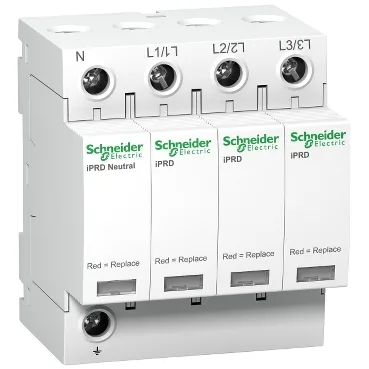
Type 2 SPD for IT networks — what the ratings mean
It's a 3P+N unit — three phase conductors plus neutral — but note the 'w/o N' in the description: the neutral path is present for the SPD's internal reference, not for load-side neutral distribution. The 40 kA maximum discharge current (Imax) per mode (L/PE and N/PE) tells you it can handle a direct lightning strike's energy without failing catastrophically; the 15 kA nominal discharge current (In) is the rating it must survive 20 surges at without degradation, per IEC 61643-11. That's the number that governs real-world service life on a distribution board.
IT-system specific — why this matters
IT earthing systems are common in hospitals, data centers, and continuous-process plants where a first insulation fault must not trip the supply. The A9L40621 is engineered for that: its MOV + GDT (metal oxide varistor plus gas discharge tube) technology handles the higher phase-to-earth voltages that appear in an IT system during a fault. The maximum continuous operating voltage (Uc) is 460 V L/PE and 260 V N/PE, and the temporary overvoltage (Ut) withstand is 337 V L/N for 5 seconds, with a safe failure mode at 1453 V L/PE for 200 ms. That means it won't explode or catch fire if the system voltage temporarily spikes above nominal — it fails safely, shorting the line to earth and tripping the upstream overcurrent device.
Clip-on DIN rail mounting, 72 mm wide (4 modular spaces at 18 mm each), 90 mm deep, 70 mm tall. Tunnel-type terminals on both top and bottom accept 2.5–25 mm² rigid or 4–16 mm² flexible — standard for panel wiring. The remote signalling contact (1 C/O, rated 0.25 A / 250 V AC) lets you wire a status back to a PLC or building management system. The white RAL 9003 housing matches the Acti9 range's aesthetic for visible distribution boards.