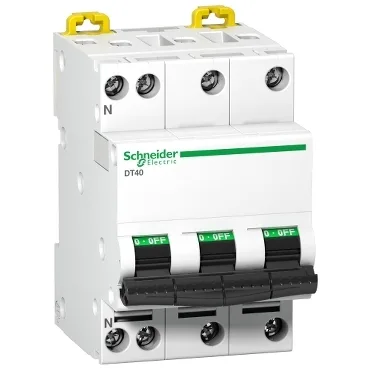
Breaking capacity is dual-rated: 6000 A Icn at 400 V AC per EN/IEC 60898-1 (the household-and-similar standard), and 10 kA Icu at 400...415 V AC per IEC 60947-2 (the industrial standard). That second figure matters when this breaker sits in an industrial panel where the prospective fault current can hit higher than a residential service entrance.
D curve and load type — why the trip characteristic matters
The D curve's magnetic trip band (10–14 x In) is the key spec for fit. A 25 A D-curve breaker will hold through the magnetizing inrush of a small motor or the charging current of a capacitor bank, where a C-curve (5–10 x In) might trip on the first half-cycle. But that same D curve also means the breaker will not clear a modest overload as quickly as a B or C — the thermal element handles the long-time overload, and the magnetic element only acts on high faults. So if your load is resistive (heaters, lighting), a D curve is overkill and you lose coordination; for motor or inductive loads, it's the right call.
The breaker occupies 6 x 9 mm pitches (54 mm wide total for the 3P+N), so plan for that footprint on the rail.
What the dual standard means for procurement
The A9N21418 is certified to both EN/IEC 60898-1 (the standard for household and similar installations) and EN/IEC 60947-2 (the industrial standard for low-voltage switchgear). That dual certification is rare in a single MCB — it means this breaker can serve in a residential distribution board (60898-1) and also in an industrial control panel (60947-2) where the inspector expects the industrial standard.