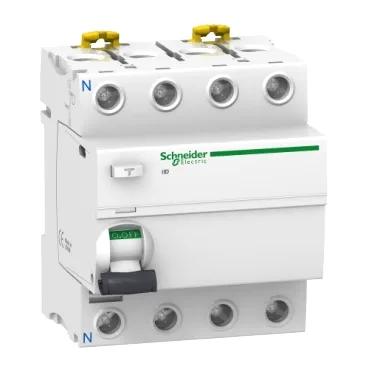
The Schneider Electric A9R82463 is a 4-pole residual current circuit breaker (RCCB) from the Acti9 iID series, rated at 63 A continuous current with a 300 mA earth-leakage sensitivity. The unit operates voltage-independently, so the tripping mechanism draws its energy from the fault current itself; it does not rely on an external supply or the line voltage to open on a ground fault. That makes it inherently fail-safe against a lost neutral or a dropped phase — a detail that matters when you are protecting a circuit that could lose a leg and still have a live fault path.
Rated operational voltage is 400...415 V AC at 50 Hz, which lands it squarely on standard European three-phase low-voltage networks — 230/400 V or 240/415 V wye systems. The 63 A frame is a common main-switch or heavy-feeder size for a distribution board feeding a sub-panel, a large commercial kitchen, or a multi-zone HVAC unit. Breaking capacity is rated at 1500 A (Idm and Im,) — that is the maximum prospective fault current the RCCB can safely interrupt. The 300 mA sensitivity is the standard for fire-protection RCCBs in many European and Asian codes — it is less sensitive than the 30 mA version used for personal shock protection, but it reduces nuisance tripping on circuits with natural leakage from long cable runs, surge suppressors, or permanently connected equipment. Use it on circuits where the load itself has a standing leakage that would trip a 30 mA device on start-up or during a lightning storm. The instantaneous time delay means it trips within the natural response time of the voltage-independent mechanism — no intentional delay for selectivity with downstream RCCBs, so plan your discrimination accordingly.
The 4-pole body is 72 mm wide — that is 4 modules at the standard 18 mm per pole — and 96 mm tall by 74.5 mm deep. At 8 pitches of 9 mm, the module count is confirmed for panel layout. Terminals accept 1 to 35 mm² rigid or 1 to 25 mm² flexible conductors; strip length is 14 mm, and tightening torque is 3.5 N·m. The neutral pole is on the left, which is the standard orientation for a 4P RCCB in a distribution board — the incoming supply must respect that polarity for the voltage-independent trip circuit to see the phase-to-neutral voltage correctly.
Pollution degree 3 — the standard for industrial enclosures where conductive pollution may occur or dry non-conductive pollution becomes conductive due to condensation. That means the RCCB is rated for the inside of a panel in a factory environment, not for a clean-room or climate-controlled office. IP20 on the body, IP40 inside a modular enclosure — the terminals are finger-safe, but the unit is not splash-proof; it belongs behind a panel door or in a weatherproof enclosure if installed outdoors. Electrical endurance is 15,000 cycles under AC-1 (resistive load) conditions; mechanical endurance is 20,000 cycles. That is a solid service life for a distribution RCCB — it will outlast most of the loads it protects.