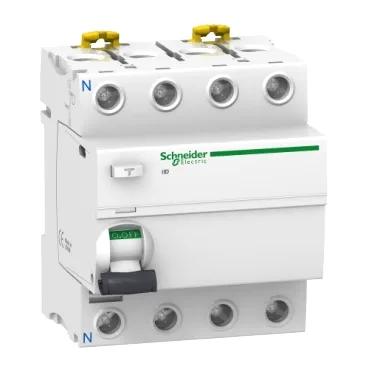
Rated for 100 A continuous and 300 mA leakage sensitivity, it sits on the outgoing side of a distribution board, clip-mounted to a DIN rail.
The 100 A continuous rating governs the main load it can carry — sized for a heavy submain or a large lighting/power panel. The 300 mA sensitivity is a common choice for protection against fire risk from earth faults rather than personnel shock (that would be 30 mA or lower). The voltage-independent tripping technology is a practical advantage: the RCCB operates regardless of whether the supply voltage is present, so it still clears a residual fault even if a neutral break or phase loss has killed the control voltage. That's a reliability point worth noting for anyone maintaining a panel where nuisance tripping or supply anomalies are common. Clip-on DIN rail mounting means it snaps onto the standard 35 mm rail inside any enclosure — no screws, no tools for the rail fix. The 4-pole format with neutral on the left is the standard arrangement for three-phase + neutral systems. The IP20 body is fine inside a closed panel; the IP40 modular enclosure rating means it's also acceptable in certain open modular assemblies where splash protection is needed.
The A9R82491 is certified to GB 16916.21 and EN/IEC 61008-1 — the core international standard for RCCBs. That covers the essential safety and performance requirements for residual current protection in most markets. The 8/20 µs impulse withstand of 250 A confirms it can ride through typical surge events without nuisance tripping, which matters in industrial environments with switching transients.