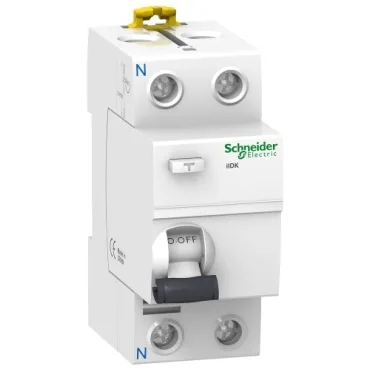
The A9R88225 is a Schneider Electric Acti9 iID K residual current circuit breaker (RCCB) — a 2-pole, 25 A, 30 mA sensitivity device for AC networks. It clips onto a DIN rail, occupies 4 x 9 mm pitches (36 mm wide), and is rated for 220-240 V AC at 50/60 Hz. The earth-leakage protection is Type AC (sensitive to sinusoidal AC residual currents only), voltage-independent, and instantaneous — no intentional delay.
The 25 A rated current (In) and 30 mA earth-leakage sensitivity define the two key selection gates. 25 A is the continuous load the RCCB can carry without tripping on thermal overload — sized for a final subcircuit feeding a group of socket outlets or a small appliance bank. If the downstream equipment includes variable-speed drives, UPS, or LED drivers that can produce DC leakage, a Type A or Type B RCCB would be required instead. The rated breaking and making capacity (Idm / Im) is 500 A — this is the maximum prospective fault current the RCCB can safely interrupt. In a domestic or light commercial panel, the upstream overcurrent device (MCB or fuse) will typically limit the fault current to well below 500 A, so this rating is adequate for most final-circuit installations. The impulse withstand rating of 200 A (8/20 µs wave) per EN/IEC 61008-1 means the device will not nuisance-trip on common surge events like lightning-induced transients on the mains. Pollution degree 2 covers normal indoor environments with occasional condensation.
This RCCB is a clip-on DIN-rail device (mounting support: DIN rail, mounting mode: clip-on). It occupies 4 module pitches (36 mm width) and is intended as an outgoer in a distribution board — meaning it sits downstream of the main switch or incoming device, feeding the final circuits.
The device complies with EN/IEC 61008-1 (the standard for residual current operated circuit-breakers without integral overcurrent protection for household and similar uses). The electromagnetic compatibility is verified with an 8/20 µs impulse withstand of 200 A per the same standard. Electrical durability is 2000 cycles under AC-1 conditions; mechanical durability is 5000 cycles.