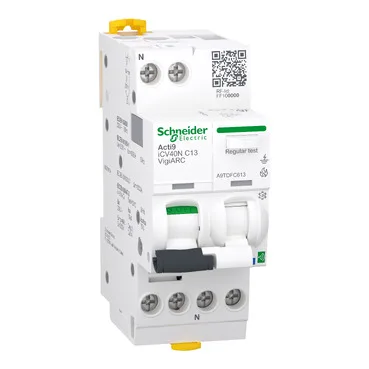
The thermal-magnetic trip handles overloads and short-circuits while the embedded electronics monitor for series and parallel arcs, tripping the circuit before a fire can start.
The 13 A rating on a Curve C trip means this unit is sized for general-purpose loads with moderate inrush — think lighting circuits, small appliances, or control transformers in a distribution board. The 10 kA Icu (ultimate breaking capacity per EN/IEC 60947-2) is the one-shot maximum it can interrupt without being destroyed — that's the number for coordination with an upstream breaker. The limitation class 3 means it lets through less energy during a short-circuit than a class 1 or 2 device, which helps protect downstream wiring and loads. The arc-fault detection meets EN/IEC 62606, which is the standard for AFDDs in residential and similar buildings. It measures voltage, current, active power, and power factor (accuracy ±2% for voltage and current, ±5% for power) to distinguish normal arcing (like a motor brush) from dangerous arcing (like a frayed cord). The local signalling includes an ON/OFF toggle, a fault-trip LED, and a dedicated arc-fault diagnostic LED — so when you walk the route and see a solid red instead of green, you know it's an arc event, not just an overload.
This is a DIN-rail clip-on device, 91 mm tall and 73 mm deep, with the neutral on the left. The 2 N.m tightening torque and 14 mm wire strip length are standard for Acti9 terminals — spring-cage or screw, same prep. It's rated for pollution degree 2 (normal indoor, non-conductive contamination) and overvoltage category III (distribution level, not the utility transformer side). The 2000 m operating altitude covers most installations below 6500 ft without derating.