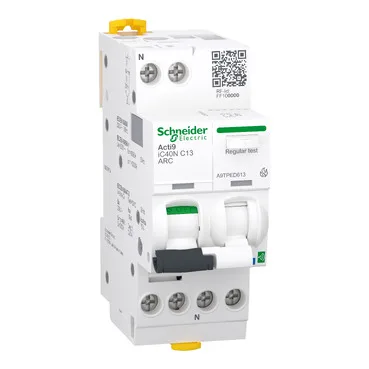
Arc-fault detection device, 13 A Curve C, 1P+N
Rated 13 A with a C trip curve, it is designed for final circuits on 230 V AC 50 Hz networks where series and parallel arcing faults need to be identified and interrupted. Breaking capacity is 6 kA Icn per EN/IEC 60898-1 and 10 kA Icu per EN/IEC 60947-2 at 230 V AC, with a limitation class 3 rating meaning it limits let-through energy effectively for downstream equipment protection. Magnetic trip threshold is 5 to 10 times In (65 to 130 A), typical for C-curve MCBs protecting inductive or lighting loads. IP20 finger-safe front face. Neutral is on the left; cable entry from top or bottom. Tightening torque spec is 2 N·m.
The 6 kA Icn (service breaking capacity) is the standard domestic/commercial level; the 10 kA Icu (ultimate breaking capacity) gives headroom for industrial panels with higher fault current. Limitation class 3 reduces arc flash energy on a downstream fault, which matters for coordination with downstream MCBs. The arc-fault detection function (Active ARC) distinguishes between normal arcing (e.g., motor brushes, switch arcing) and dangerous series/parallel arcs. It logs event data with date/time stamps and maintenance indicators — useful for post-fault analysis. Accuracy of the measurement function: voltage and current ±2 %, power ±5 %. Rated for 2000 m altitude, pollution degree 2 (non-conductive dust, occasional condensation). Tropicalisation severity B per IEC 60068-2-30 for 28 days — suitable for warm, humid environments.
The device integrates overcurrent protection (thermal-magnetic trip), earth leakage detection, and arc-fault detection in one unit. Local signalling includes ON/OFF status and a fault-trip LED with arc-fault diagnostic indication.
This is a current-production part from Schneider Electric's Acti9 range.