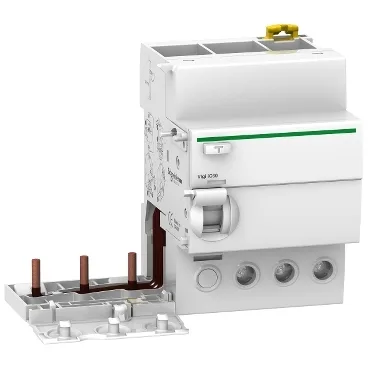
It's a 3-pole unit rated 63 A with 1000 mA sensitivity, AC type (sinusoidal AC fault detection), and selective (time-delayed) tripping to coordinate with downstream RCDs. Mounts on DIN rail via the clip-on mechanism, occupying 7 x 9 mm pitches (117 mm width).
The 63 A rated current (In) matches the upstream MCB's frame — this block is sized for a 63 A outgoing circuit, not for general-purpose 40 A or 25 A feeders. The 1000 mA sensitivity is a deliberate choice: it's not for personnel protection (which typically requires 30 mA), but for equipment protection or fire prevention on large circuits where nuisance tripping from normal leakage must be avoided. The selective (time-delayed) characteristic means it holds through transient earth faults and lets downstream 30 mA RCDs trip first — essential for discrimination in a multi-level distribution board. Rated operational voltage covers 230...415 V AC 50/60 Hz, which spans single-phase and three-phase networks up to 415 V line-to-line. Insulation voltage is 500 V AC, and impulse withstand is 6 kV — adequate for standard industrial and commercial panels. The AC-type detection handles sinusoidal faults only; if the installation has electronic loads generating pulsed or DC fault currents, a Type A or Type B RCD would be needed instead.
Clip-on mounting to DIN rail, 7 module pitches wide (117 mm). Strip length 14 mm for bottom connections. Bottom busbar compatible, which simplifies distribution in multi-circuit panels. Operating temperature range -5...60 °C, storage -40...85 °C. The trip indicator gives local visual confirmation of RCD operation — useful during fault-finding without needing to meter the circuit.