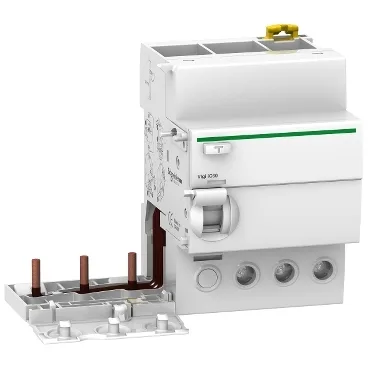
The Schneider Electric A9V25363 is an add-on residual current device (RCD) from the Acti9 Vigi iC60 range, designed to clip onto the outgoing side of an iC60 MCB. The selective (time-delayed) characteristic means it holds off for a short period during a fault, allowing downstream RCDs to clear first — essential for discrimination in multi-level distribution boards so a ground fault on a sub-circuit doesn't take out the whole panel.
Clip-on mounting onto DIN rail, 7 x 9 mm pitches wide (117 mm). The tunnel-type terminals at the bottom accept 1…35 mm² rigid or 1…25 mm² flexible cable, stripped 14 mm, torqued to 3.5 N·m. Electrical connection to the upstream MCB is by screws — no separate wiring needed for the phase bus. IP20 finger-safe on the front; IP40 inside the modular enclosure once installed.
There is no official direct replacement from Schneider — the Acti9 range has evolved, and a parametric substitute would need to be evaluated for fit (same 3P, 63 A, Type A, 300 mA, selective, voltage-independent trip).
Rated operational voltage 230…415 V AC, 50/60 Hz — covers single-phase (230 V between phase and neutral) and three-phase (400/415 V between phases) networks common across Europe and much of Asia. Rated insulation voltage 500 V AC, impulse withstand 6 kV per IEC 60947-2. The residual current tripping technology is voltage-independent — it does not need an external power supply to detect a fault and trip. This is a safety advantage: the RCD will still operate even if the neutral is lost or the supply voltage drops. 8/20 µs impulse withstand rated at 3000 A per IEC 61009-1 — the device will not nuisance-trip from lightning-induced surges or switching transients up to that level. Operating temperature range -25…60 °C, storage -40…85 °C — suitable for indoor panel environments in most climates, including unheated enclosures.