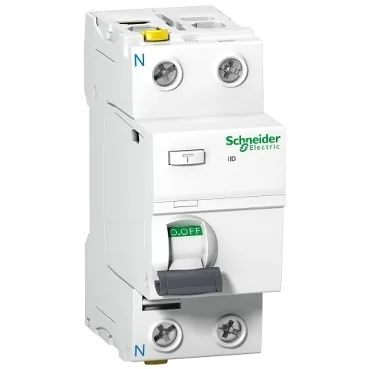
The Schneider Electric A9Z11280 is an Acti9 iID 2-pole residual current circuit breaker (RCCB) rated 80 A with 30 mA earth-leakage sensitivity, Type AC, designed for clip-on mounting on DIN rail. It protects against sinusoidal AC fault currents in residential and commercial distribution boards where the load is predominantly resistive or inductive with minimal DC component.
The 80 A rated current ([In]) means this RCCB can carry continuous load up to 80 A without nuisance tripping — sized for sub-mains or heavy feeder circuits, not final sub-circuits. The 30 mA sensitivity catches leakage currents that would otherwise go undetected until someone becomes part of the path; it's the standard threshold for personnel protection in most IEC-based codes. Type AC detection means it only responds to sinusoidal AC residual currents — no pulsed DC or smooth DC. If the downstream load includes VFDs, UPS, or LED drivers that generate DC leakage, you need a Type A or Type B device instead. Breaking capacity is rated Idm 1500 A and Im 1500 A per EN/IEC 61008-1, with a conditional short-circuit current (SCCR) of 10 kA when backed by an upstream overcurrent device. The 10 kA figure tells you the maximum prospective fault current this RCCB can survive under test conditions with a suitable MCB or fuse ahead of it. In a panel with available fault current above 10 kA, the RCCB must be coordinated with a current-limiting breaker or the panel's SCCR must be re-evaluated. Insulation voltage (Ui) is 500 V AC, impulse withstand (Uimp) is 6 kV.
Neutral is on the left. IP20 on the device body (finger-safe), IP40 inside a modular enclosure. The electrical durability is 10,000 cycles under AC-1 (resistive) load; mechanical durability is 20,000 cycles — figures that matter if the RCCB is used as a manual switch, not just as a protective device.