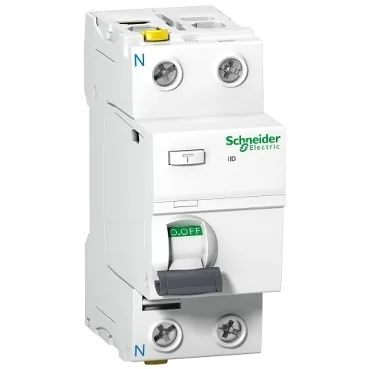
The Schneider Electric A9Z14240 is a 2-pole Acti9 iID RCCB rated for 40 A continuous current with 300 mA Type AC earth-leakage sensitivity. It operates on 220-240 V AC networks at 50/60 Hz and trips instantaneously. Clip it onto a DIN rail — the mounting mode is clip-on, neutral on the left, and the toggle control gives a positive contact-position indicator so you can see the state without opening the panel. The 4-module width (36 mm per pitch, 9 mm pitches = 4) fits standard DIN-rail enclosures; plan for 4 TE in your rail budget. Rated breaking capacity Idm is 1500 A, and impulse withstand voltage is 6 kV — numbers that confirm coordination with downstream MCBs in a typical residential or light-commercial distribution board. The insulation voltage is rated 500 V AC, so it has headroom above the 240 V operating level.
Terminals accept double front or back entry: rigid up to 35 mm² front, 25 mm² back; flexible with ferrule up to 25 mm² front, 16 mm² back. Strip length is 14 mm for both top and bottom connections. IP20 on the body (finger-safe), IP40 in a modular enclosure — fine for clean indoor distribution boards.
Electromagnetic compatibility is verified with an 8/20 µs impulse withstand of 250 A per the same standard. The tripping technology is voltage independent — the RCCB detects leakage current and trips even if the mains voltage is lost or severely distorted. That makes it suitable for circuits where supply continuity is uncertain or where the neutral-to-earth voltage might be elevated. Electrical durability is rated at 15,000 cycles under AC-1 (resistive) load; mechanical durability is 20,000 cycles. These are the expected service life under normal switching — not a guarantee, but a design target for the mechanism and contacts.